

Ding-dong! The doorbell rings.
Aman stands outside, ringing the doorbell of… Aman.
Both are hungry. Both are glued to their phone screens. But their worlds couldn’t be more different.
Aman-2 just wrapped up a $1000 freelance project—weeks of effort, now safely secured with a contractual guarantee. He has a health insurance plan, a financial cushion, and the luxury of choosing when to work.
Aman-1, on the other hand, is racing against time, completing his 20th delivery of the day—for an earning of ₹25. No safety net. No protections. One emergency away from losing everything.
Both Amans are part of the gig economy: where work flexibility goes hand-in-hand with financial uncertainty, and one person's convenience often comes at the cost of another’s chaos.
Gig work is simple—short-term, task-based jobs with no long-term contracts. Think of it as work on demand. And when you add up all these gigs? That’s the gig economy.
India’s gig economy isn’t just growing—it’s booming. In 2021, we had 77 lakh gig workers. By 2023, that number crossed 1 crore, and by 2030, it’s expected to reach 2.35 crore. This isn’t just a trend—it’s becoming a key pillar of the economy, projected to contribute ~1.25% to India’s GDP by then.
Gig workers in India fall into two broad categories.
Platform-based workers include your cab drivers, food delivery agents, and others who work through digital platforms. These are mostly regarded as middle-to-low-skilled jobs, forming ~78% of the gig workforce.
Non-platform workers are freelancers, independent professionals, and casual wage workers operating outside these platforms. They are mostly domain experts who offer their expertise through gig work.
And the majority of gig work is being led by youth, with 40% of gig workers between 16 and 23 years old. While gig work may have started as a side hustle for some, it is now shaping the future of work.
Let’s understand the nuances of Gig Economy or Gig Work.
Firstly, the mode of engagement. Most gig platforms call their workers “independent contractors” or “partners”—which sounds empowering until you realize it’s just a fancy way of saying no benefits, no protections, and no bargaining power. No minimum wage, no paid leave, no social security. And while platforms promise flexibility, rejecting assignments often leads to penalties—because, apparently, flexibility only works one way. A recent TISS report highlights how these penalties erode worker autonomy, turning ‘gig work’ into ‘gig servitude’.
Then there’s the money problem. Platforms claim high earning potential, but the reality is far less glamorous. Most ride-hailing platforms take 25-40% commissions, squeezing driver earnings. Uber recently dropped its commission model after protests, but that’s just one battle in a long war. Food delivery and e-commerce gigs run on a pay-per-delivery model, with payouts ranging from ₹10 to ₹50 per order, depending on factors like demand, location, and how generous the algorithm is feeling that day. For many, it’s a daily gamble rather than a stable income.
And if financial uncertainty wasn’t enough, gig work can be deeply isolating. With 98.5% of gig workers reporting stress, anxiety, or depression, it's clear that algorithm-driven work schedules don’t come with peace of mind. Traditional worker communities, like auto stands, are disappearing, leaving gig workers without social support. It’s a lonely grind, where the only “team meetings” happen in app notifications, removing the potential of group negotiating powers.
So, is the economy self-regulating, or is the government stepping in? The Indian government has tried a few things—but let’s just say execution hasn’t always been smooth.
The Social Security Code 2020 was the first official recognition of gig workers. But instead of granting them full employee benefits, it nudged them toward social security schemes—which sound nice, but remain limited in reach. While the Code enabled gig workers to access life and disability cover, health benefits, maternity benefits, and old-age protection, it still lacked strong enforcement mechanisms.
Then came the e-Shram Portal in 2021, designed to bring unorganized workers under social security schemes. Great idea, but execution has been sluggish. The rigid classification of job roles doesn’t fit gig work’s fluid nature, and workers report struggling to register. Many find the process so tedious that they just skip it altogether. Originally meant to provide gig workers access to insurance, employment assistance, and pension schemes, the platform’s limited outreach and bureaucratic hurdles have made it ineffective.
Meanwhile, some states are leading the charge. Rajasthan passed the Platform-Based Gig Workers Registration and Welfare Act, 2023, setting up a welfare board and tracking gig work transactions. Karnataka is working on similar legislation to ensure fair pay, job security, and protection from arbitrary dismissals. While these efforts signal progress, enforcement remains a challenge.
At the national level, the recent Union Budget saw Finance Minister Nirmala Sitharaman announce identity cards and a registration process for gig workers—an attempt to formalize the sector. But as always, the real question is: Will these policies translate into real change, or just more paperwork?
Looking at international models, the European Union’s Platform Workers Directive (2024) is ensuring that misclassified gig workers get proper employee rights. Meanwhile, the UK has recognized ‘worker’ as a distinct category entitled to minimum wage, paid leave, and pensions. In 2021, the UK Supreme Court ruled that Uber drivers were, in fact, workers, a decision that sent ripples through the industry and invited significant resistance from the aggregators.
So, what needs to change?
Time to Drop the “Independent Contractor” Facade: Gig workers need legal recognition as employees, with access to minimum wages, paid leave, and job security. The gig economy thrives on their labor—it’s only fair that they receive proper protections.
Expand Social Security Benefits: The Social Security Code should be strengthened to ensure gig workers receive institutional benefits, not just scheme assistance.
Set Up Grievance Redressal Mechanisms: Unfair deductions, arbitrary deactivations, and payment disputes need structured resolution channels. Right now, workers are at the mercy of faceless algorithms.
Algorithmic Transparency is Non-Negotiable: Platforms should disclose how earnings, penalties, and job assignments are determined. If a worker’s livelihood is controlled by an app, they at least deserve to know how it makes these decisions.
India’s gig economy is at a crossroads. On one hand, it offers employment opportunities in a rapidly changing job market and absorbs the frustration of unemployment widespread among the country’s youth. On the other, it leaves millions vulnerable to exploitation. If India truly wants to become a gig-driven economy, it must find a way to balance flexibility with fairness, innovation with integrity, and profits with protections. Because at the end of the day, an economy that thrives at the cost of its workers isn’t a sustainable one—it’s just another ticking time bomb.
Book Mandala
In this section, we suggest a book to be read/listened to each week, for the inner policy enthusiast in you :)
Book: The Gig Economy in India: Start-Ups, Infrastructure and Resistance
Author: Pradip Ninan Thomas
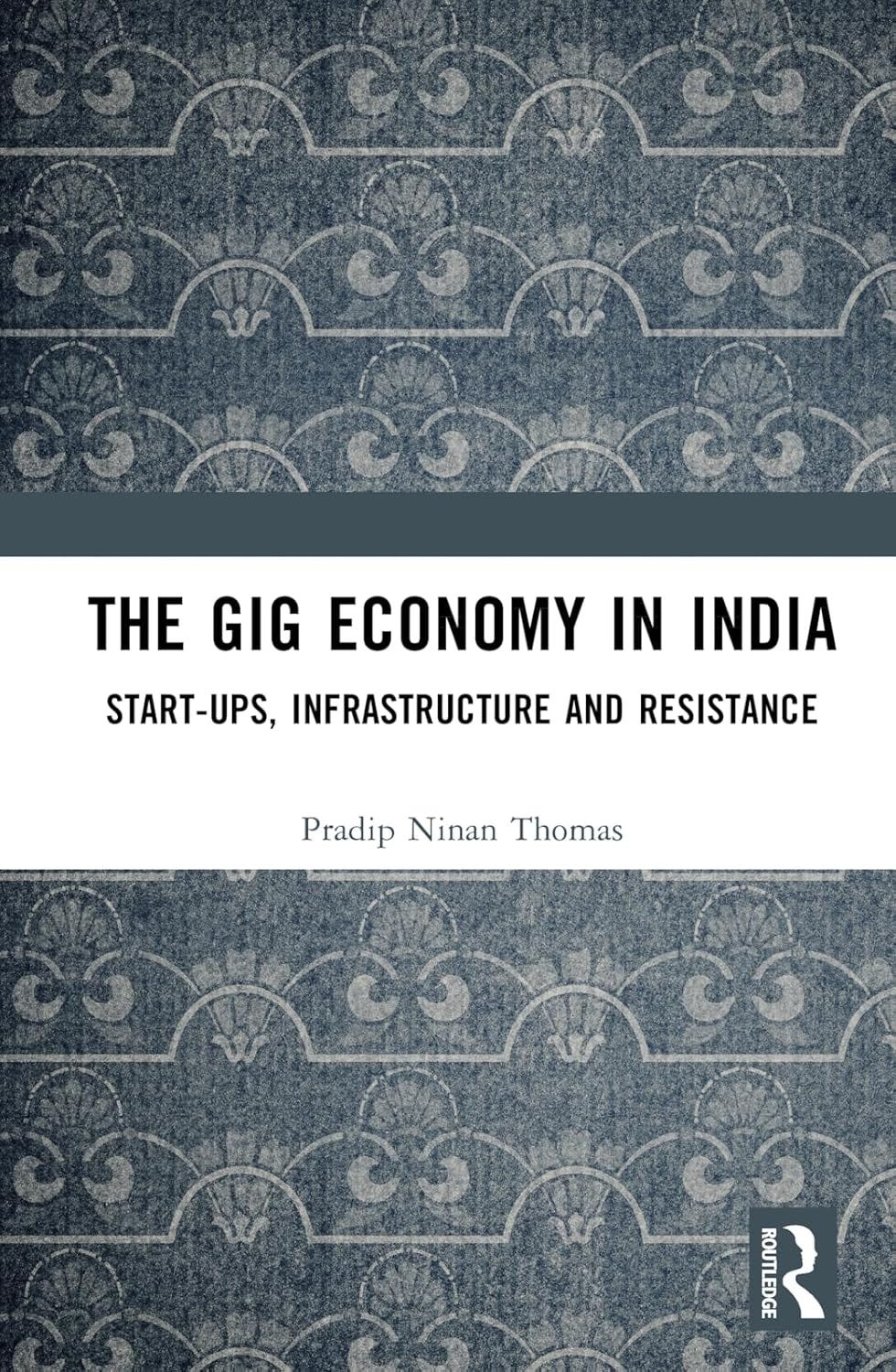
About the Book:
The Gig Economy in India: Start-Ups, Infrastructure and Resistance by Pradip Ninan Thomas provides an in-depth analysis of India’s growing gig economy, highlighting its opportunities, challenges, and structural complexities. The book explores the intersection of technology, labour, and policy, offering insights into how digital platforms like Ola, Uber, Swiggy, and Zomato have reshaped work and employment.
Through a mix of theoretical perspectives and real-world examples, the book presents a well-rounded view of the gig economy’s impact on India’s workforce. It is a valuable resource for students, researchers, policymakers, and anyone interested in the future of work in India.
Our Take:
Pradip Ninan Thomas presents a sharp and well-researched critique of India's gig economy, going beyond the usual narratives of innovation and flexibility to highlight the deeper structural issues. The book does an excellent job of placing India's gig economy in a global context while also highlighting uniquely Indian factors, such as regulatory gaps, informal labor traditions, and digital financial systems.
Overall, "The Gig Economy in India" is an insightful, critical, and timely read for anyone looking to understand the realities of platform work in India. It moves beyond surface-level discussions and forces the reader to question the sustainability of this new labor model. Highly recommended for policymakers, academics, and anyone interested in labor rights and the future of work.
Hope you liked today’s Policy Mandala!
We believe nation-building needs a community of changemakers, so we’re creating Bharat Mandala, an ecosystem for impact. Be a part of our journey here!
Thanks for reading Policy Mandala! Subscribe for free to receive new posts and support our work.
From a Marxist perspective it is a perfect example of the exploitative nature of Capitalist societies.
Very informative post. Looking forward to reading more from policy mandala.