
“Bacche do saal mein Kota se nikal jaate hain, par Kota saalon tak bacchon se nahi nikalta.”
If you chuckled, nodded, or sighed while reading that line, you know exactly what we’re talking about.
Maybe you’ve binge-watched Kota Factory. Maybe your cousin did a two-year vanvaas in Kota chasing that elusive IIT seat. Or maybe you’re one of the few who survived the daily practice papers, weekly tests, and the monthly “All India Test Series” in India’s most intense coaching town.
Because Kota isn’t just a city—it’s an emotion, and an industry. It’s also India’s coaching capital. Every year, over 2 lakh students descend upon it with dreams of cracking JEE and NEET, while a parallel economy rises to serve them—hostels, messes, autos, chai tapris, and a never-ending stream of photocopied question papers.
But why are we discussing Kota in Policy Mandala?
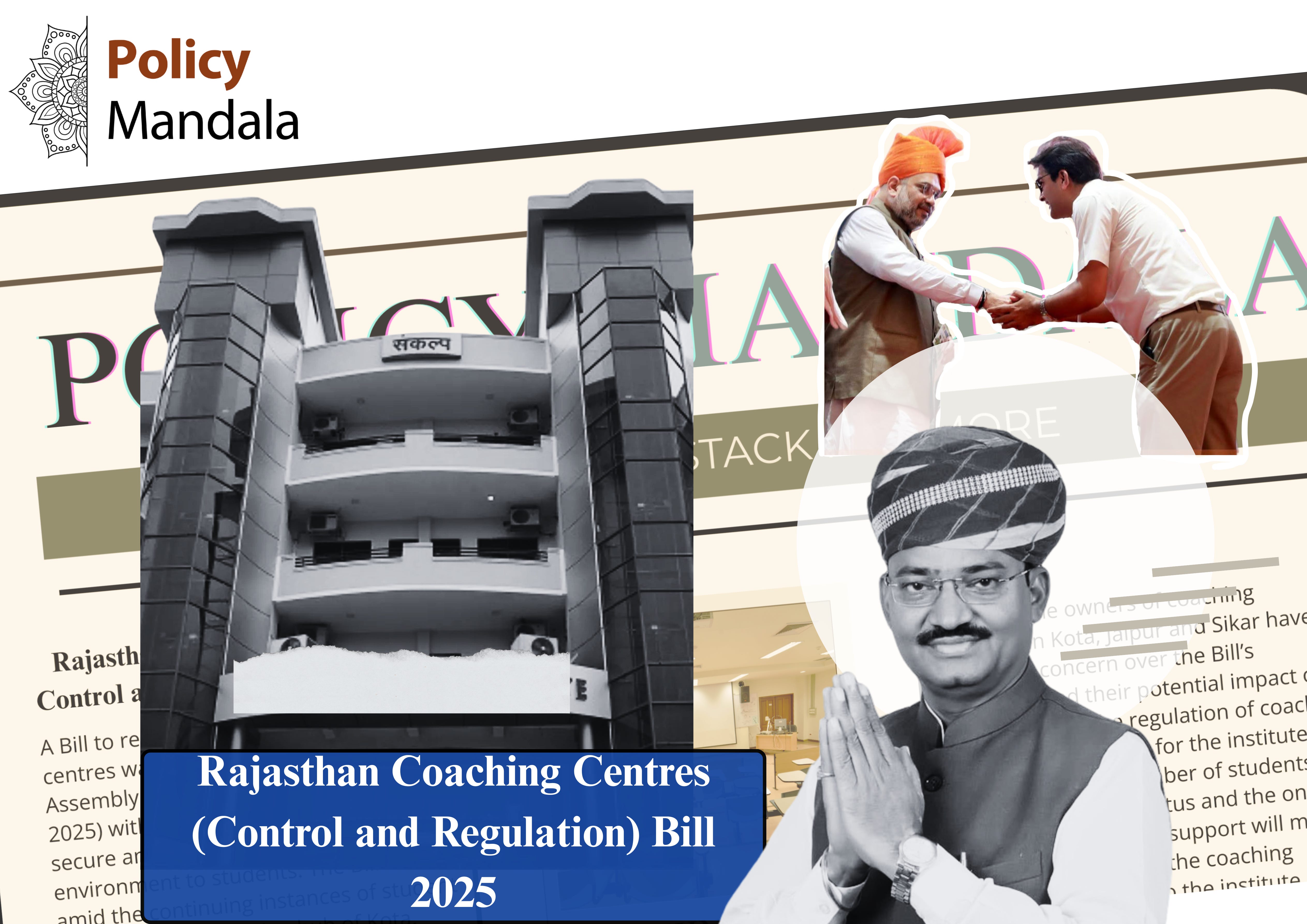
Because a few weeks back, the Rajasthan government introduced the Rajasthan Coaching Centre (Control and Regulation) Bill, 2025, which aims to bring some structure—and a little compassion—to this high-pressure industry. Though it primarily impacts Kota, it opens up a much-needed conversation for the whole country.
Before we dive into the fine print, let’s zoom out.
Kota’s coaching industry employs over 3.5 lakh people, pays ₹700 crore in taxes, and generates ₹5,000 crore in revenue annually. That’s more than 7 times what the Rajasthan government allocates for funding startups across the state in a year. Zoom out even further, and India’s coaching industry is now valued at ₹58,000 crore, growing at 15% annually.
But there’s a dark side. In 2023, 28 students in Kota died by suicide. That number shook the country. It forced policymakers to look closely at what’s broken in the coaching model—and how to fix it. The first result was a bill in 2024. It never reached the execution stage. So in 2025, a revised version made its way to the Assembly, with new energy—and a few notable changes.
The Rajasthan Coaching Centre (Control and Regulation) Bill, 2025, is structured around three big themes: government oversight, mandatory mental health support, and district and state-level regulatory committees.
Compared to the 2024 draft, this version carries sharper penalties, clearer mandates—and a few curious omissions.
One of the most welcome additions is a rule on fee refunds. If a student decides to withdraw, the institute must refund the unused portion of the tuition, hostel, and mess fees—within ten days. But this applies only to coaching institutions; independent mess and hostel owners are not covered under this mandate.
The fines have also been ramped up. The penalty for a first violation has jumped from ₹25,000 to ₹2 lakh. Repeat offences? ₹5 lakh, up from ₹1 lakh. Sounds tough—but in an industry where a top teacher might earn that much in less than a week, one wonders: are these fines serious deterrents, or just symbolic gestures?
Now, let’s talk about what the new bill quietly drops.
Between the 2024 and 2025 versions, the provision barring students under 16 from joining coaching institutes seems to have vanished. There’s no official explanation, but the coaching lobby had pushed back hard on this in 2024. So, did the government bend—or compromise? We can only guess until they clarify.
Also missing are requirements for disabled-friendly infrastructure and batch segregation based on academic performance. These were meant to support inclusivity and create healthier learning environments—but perhaps they were seen as “too much” for coaching centres to comply with. Again, the government hasn’t said why these have been removed.
To be fair, this isn’t Rajasthan’s first attempt at coaching regulation.
In 2022, the government tried to introduce a similar law—the Rajasthan Private Educational Regulatory Authority Bill—but it never made it to the floor, owing to objections from legal bodies. Even earlier, in 2018, the state had issued guidelines asking institutes to cap daily study hours and maintain attendance. But those were advisory.
Other states have tried too. Tamil Nadu, back in 2019, attempted to cap coaching fees. Several others—like Haryana (2024), Bihar (2010), Goa (2001), Uttar Pradesh (2002), Karnataka (2001), Manipur, and Jammu & Kashmir (2010)—have also passed coaching regulation laws in their respective jurisdictions. But enforcement has been patchy, and coaching lobbies, predictably, powerful.
Compared to those efforts, the 2025 Rajasthan Bill appears to have some legal and institutional teeth, finally giving regulators the power to intervene, at least in small but meaningful ways.
So where do we go from here? What should India’s roadmap look like when it comes to regulating—and ultimately, rethinking—coaching?
At India House, we believe it needs a multi-layered approach.
Let’s start at the top. At the central level, we need to break the tyranny of the once-a-year exam. Multiple attempts, multiple pathways—aptitude-based entry, even vocational routes—can help reduce the make-or-break anxiety students face in competitive exams. This is already part of NEP 2020’s vision—but we’re still waiting for it to move from paper to practice.
Next, we need a strong state-level push. States must invest in decentralised education hubs, so that students don’t have to leave their families and travel halfway across the country at 14 or 15. Better local infrastructure means students can study closer to home, in safer, less isolating environments. Some states like Telangana and Maharashtra have tried—but the effort has fallen short of what’s needed.
And finally, at the Rajasthan level, the current bill needs to go further. A minimum age cap for coaching admissions must return. Independent mental health counsellors should be made affordable and accessible—whether through subsidies, incentives, or other mechanisms. Coaching hubs like Kota should be mandated to offer well-being services—from mindfulness centres to sports facilities—so that students have outlets beyond their books. Everyone needs a pressure valve.
Because, for lakhs of students and their families, Kota is both a lifeline and a burden. It helps students reach their dreams—but often at the cost of their mental peace, social life, and well-being.
The bigger question we must ask is: should we keep fixing coaching institutes, or fix the education system that made them necessary in the first place?
The answer probably lies somewhere in between.
But the real work begins when we ask these questions—not just in Parliament, but in every parent-teacher meeting, every policy brainstorm, and every drawing-room conversation. Because the future of India’s young minds should not be left to chance, pressure, or photocopied notes. It should be built on care, creativity, and a system that believes in nurturing—not breaking—them.
Hopefully, our policies will evolve from mere regulation to also becoming a guiding light. Because let’s not forget—while the ink on the Bill is still drying, eight dreams have already been extinguished by the weight of expectation—and the calendar still reads April.
Book Mandala
In this section, we suggest a book to be read/listened to each week, for the inner policy enthusiast in you :)
Book: The Beautiful Tree: Indigenous Indian Education in the Eighteenth Century
Author: Dharampal

Dharampal’s The Beautiful Tree challenges the widely held belief that India lacked a structured education system before the British. Based on archival records from colonial surveys, the book paints a fascinating picture of a decentralized, community-driven schooling system that was inclusive, widespread, and largely self-sustained. It highlights how schools in 18th-century India functioned across regions, cutting through caste and economic divisions, and provided practical, need-based learning.
However, British interventions systematically dismantled this indigenous model, replacing it with a rigid, standardized system that prioritized administrative efficiency over holistic learning. The book compiles records from a survey ordered by Thomas Munro, Governor of Madras (1822), detailing indigenous schools across 21 districts of the Madras Presidency. It also includes reports by W. Adam (1835-38) and G.W. Leitner (1882) on education in Bengal and Punjab.
Our Take:
Dharampal’s research is both an eye-opener and a provocation. It forces us to rethink whether our present education system—marked by intense competition and coaching dependence—is a natural progression or a deviation from a more balanced, community-centered learning tradition. The Beautiful Tree serves as a reminder that the needs of the education system in India may not lie in borrowed models but in revisiting and reimagining its own historical strengths.
For those interested in education policy, history, and systemic reform, this book is an essential read. It not only questions the roots of our current learning crisis but also opens the door for rethinking what meaningful education should look like in India.
Co-authored by Mrinal Rai and Aswathi Prakash.
Hope you liked today’s Policy Mandala!
We believe nation-building needs a community of changemakers—so we’re creating Bharat Mandala, an ecosystem for impact. Be part of our journey here!
Thanks for reading Policy Mandala! Subscribe for free to receive new posts and support our work.
Insightful