
News Mandala: What, Why, and How of Recent Policy
Below, we discuss three recent policy updates from the past week(s), and present them for you: From a pension program for minors to the new AI-driven trademark search technology to covering some global geo-political developments! Let’s start.

News #1: Your ‘Saarthi’ for Trademarks is here.
And it’s AI-powered!
Last week the government launched Saarthi, an AI-powered search bot for trademarks, improving the process's transparency, efficiency, and accuracy.
This is an addition to the series of continuing of the streamlining processes for the IP process by the government since 2016, including:
Increasing IP registration manpower: Increasing yearly patent grants fourfold (2016-21).
Simplifying the e-filing process has increased their percentage from 30% to >95% in the last 8 years.
Streamlining the process, thus consolidating the application from 74 to 8 forms.
Reducing patent fees for startups, MSMEs, women entrepreneurs, individuals, and academic institutions by 80%.
Innovation is the backbone of a developing nation’s journey, and this focused commitment to building an efficient, transparent, and user-friendly IP ecosystem will bear long-term consequences for India’s development.
News #2: Sri Lanka’s Left Turn: Should India Be Concerned?
Sri Lanka recently elected Anura Kumara Dissanayake (AKD) as President in an election fought on issues of economic development. AKD is the leader of the left-leaning Janatha Vimukthi Peramuna (JVP) and has pledged economic reforms, anti-corruption measures, and continued work with the IMF.
While the JVP has a history of anti-India sentiments, AKD's campaign emphasized stronger ties with India, acknowledging New Delhi’s support during the recent Sri Lanka's 2022 Economic crisis. India's response to the new leader has been warm and positive, with PM Modi extending a hand of friendship to the new leader. However, concerns remain as China’s influence persists, with high debt and the Hambantota port lease, posing a security risk to India.
While we wait for the new leader’s policy to emerge, the real question is: what will win: Goodwill Friendship with India? Chinese Debt Diplomacy? Ideological Alignment? Or Realpolitik Balancing of Interests?
Only time will tell.
Analysis Mandala: Deepening Policy Understanding
Below, we discuss two recent policy updates from the past week(s), and analyze them for you: From the recently launched Pension Scheme for kids (Yes, you read it right!) to a ‘New’ program for tribal development that isn’t new!
Let’s go!
Analysis #1: Making kids retirement ready. Government launches NPS Vatsalya

What’s the right age to plan for retirement?
How much is enough for retiring?
Is your answer: 20, 30, 40 or 50 years of age?
Well, the government thinks it’s never too early to start—so much so that they want you to start planning for your kids’ retirement when they’re still in diapers!
Last week, the government launched NPS Vatsalya, a unique pension scheme for minors. You can now start saving for your little ones with as little as ₹1000 per annum (no upper cap), which will seamlessly transition into their own NPS accounts when they turn 18. Plus, it allows for partial withdrawals for education and medical needs. Talk about a head start!
Unlike traditional financial products for children like bank FDs, PPFs, or Mutual Funds, NPS Vatsalya offers market-linked returns with a customizable portfolio between debt and equity. Sounds attractive, doesn’t it?
Here’s why this policy is a game-changer and futuristic:
Demographic Shift: India’s senior citizens (60+) will more than double in the next three decades. These are the same kids who are in diapers and playing with toys now!
Medical Advancements: Longer lifespans for your kids mean longer retirements as well.
Gig Economy: The younger generation’s shift to gig work makes self-driven retirement planning essential.
Okay. So the future needs more economic security, and hence a pension in retirement makes sense. But, isn’t pension planning for minors a bit too early?
Well, in investment terms, the earlier, the better. Let’s look at two scenarios:
Person A’s parents start an NPS Vatsalya for their child at age 5 with a monthly SIP of ₹5000, totaling ₹33 Lakhs by age 60.
Person B starts investing at age 20 with a monthly SIP of ₹10,000, totaling ₹48 Lakhs by age 60.
At 60, Person A will have around ₹12 Crores, while Person B will have ₹5 Crores, assuming 9.6% returns in both cases (same as average NPS returns). All thanks to Person A’s forward-thinking parents. That’s the magic of compounding!
In essence, NPS Vatsalya leverages the existing infrastructure of NPS to meet changing demographic needs while also promoting responsible saving habits from a young age.
What do you think? Are Indian parents ready to plan retirement for their kids?
Analysis #2: Government launches ‘new’ scheme for Tribal Development. Or is it?

Ask any policy enthusiast: What’s the bigger issue—policy design or implementation? Most would point to implementation.
Bureaucratic delays and missing coordination often turn great policy ideas into mere pipe dreams. This is why despite more than 7 decades of independence, our tribal areas still lag economically in India’s development journey.
To tackle this, about 10 months ago, the central government launched the Pradhan Mantri Janjati Adivasi Nyaya Maha Abhiyan (PMJANMAN) aimed at improving the socio-economic conditions of 75 Particularly Vulnerable Tribal Groups (PVTGs).
After a successful 10-month pilot, the government recently announced an extended version: the Pradhan Mantri Janjatiya Unnat Gram Abhiyan (PMJUGA).
So, what’s new? PMJUGA expands the PMJANMAN model from 11 interventions to 25, and 9 ministries to 17, and aims for saturation coverage of some critical social development schemes in tribal-majority villages and aspirational districts.
Wait, did I say existing? Is it new or existing?
Here’s the twist: PMJUGA isn’t a new scheme but rather an umbrella program.
It brings key ministries together to focus on specific geographies, promote convergence, and ensure holistic development of over 63,000 villages across 549 districts, with a budget outlay of around ₹80,000 crores. This is the ‘Whole of Government’ approach, where ministries don’t work in silos, but synergize efforts in outreach, and actions, for shared developmental outcomes.
The program aims to achieve four goals for tribal development:
Infrastructure development for individuals (like housing etc) and villages (like roads etc).
Economic empowerment through skilling, marketing, agriculture, tourism, etc.
Educational access by setting up tribal hostels.
Healthy living via Mobile Medical Units, Ayushman Cards, and Poshan Abhiyaan.
The government aims to improve governance by synchronizing efforts across ministries, similar to successful schemes like PM Gati Shakti and the Aspirational Districts Program.
Fingers crossed for this synergized approach to development!
What do you think will this work, or become another example of failed execution?
Book Mandala
In this section, we suggest a book to be read/listened each week, for the inner policy enthusiast in you :)
Book: In service of the Republic
Author: Vijay Kelkar and Ajay Shah
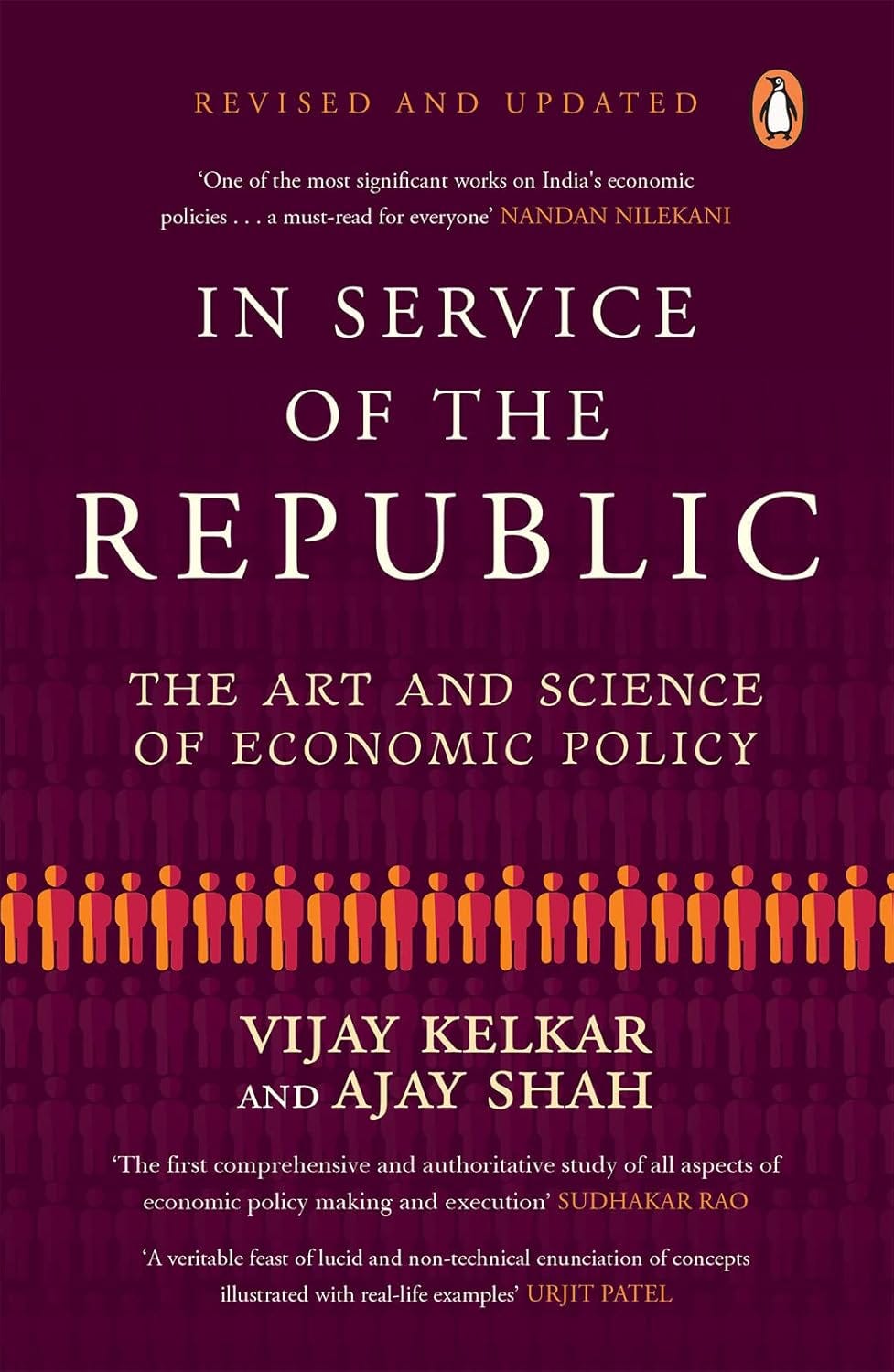
Service of the Republic offers a comprehensive analysis of the challenges and strategies involved in shaping effective economic policy in India. Drawing on key reforms like the 1991 liberalization, Goods and Services Tax (GST) the book illustrates insights into how strong institutions and state capacity are crucial for policy success. The authors emphasize the dynamic nature of policymaking and advocate for inclusive growth. Through practical examples, the author highlights the importance of perseverance, adaptability, and innovation in overcoming bureaucratic challenges to drive impactful change in economic governance.
Our Take: What should the government do, and what should the government don’t do? This book takes us on an adventure ride into various ways of decision-making of government.
If you are young policymakers, looking for a framework to understand the reform process, here’s a book offering the liberal lens to look at the world.