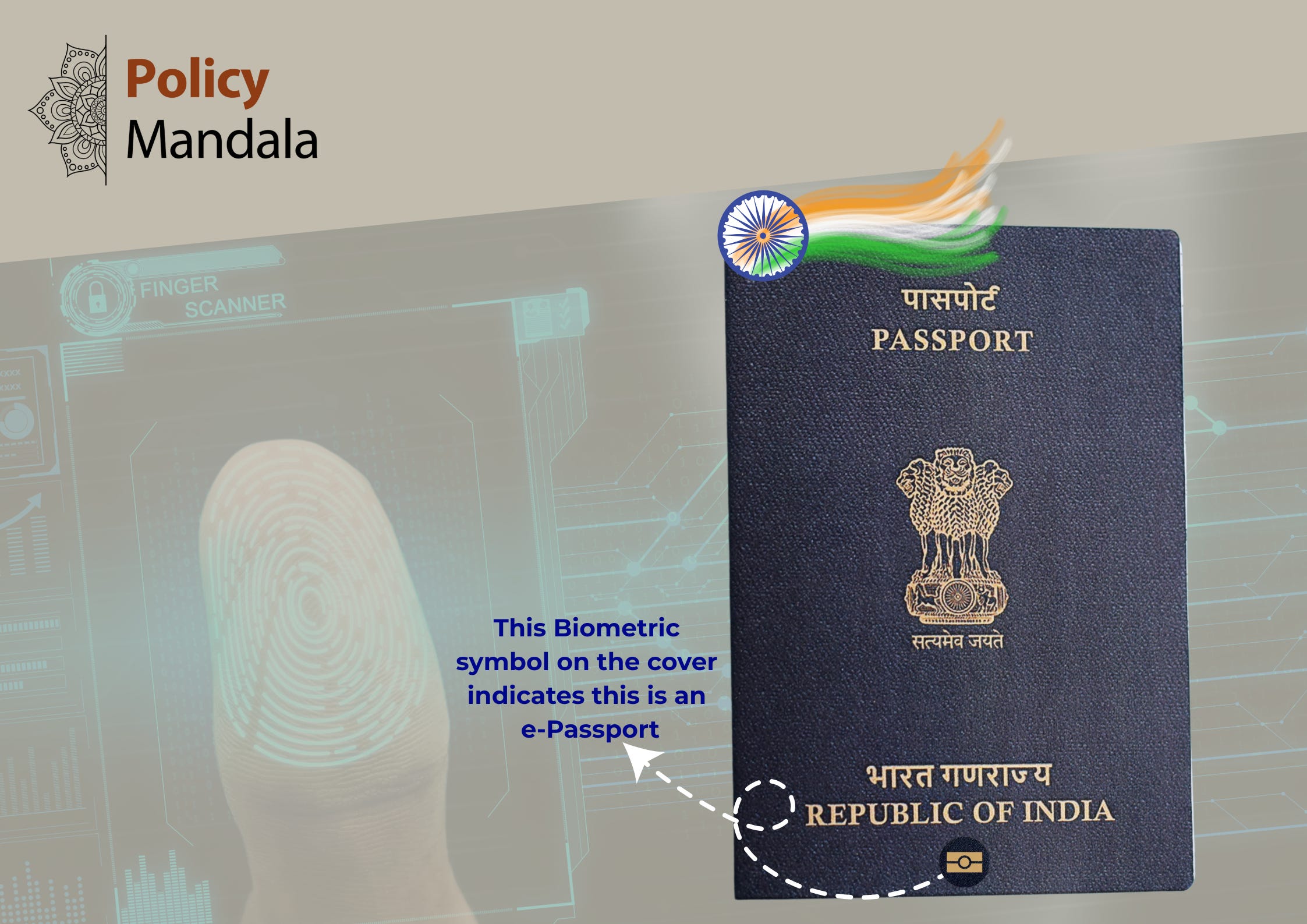
You tap your metro card to enter the station and breeze through DigiYatra boarding at the airport. But at immigration, it’s still long lines and passport stamps. That’s about to change—India’s stepping into the future with e-passports.
An ePassport looks like a regular passport but houses a secure Radio Frequency Identity (RFID) chip storing your name, photo, fingerprints, and digital signature — all encrypted and ICAO (International Civil Aviation Organisation) compliant, which makes global operability easier, bringing India in line with over 140 countries which issue e-passports. It’s like giving your passport a secure brain.
This chip does something more subtle, too: it rewrites how personal data is shared. Your address and parents’ names are no longer printed but stored inside the chip—accessible only to authorized officials via secure scans. Think of your passport putting on noise-cancelling headphones: it only listens and speaks to the right people.
Under the government’s Passport Seva Programme 2.0, e-passports launched a pilot in April 2024 across 13 cities, with a nationwide rollout set for mid-2025. Sounds great, right?
However, India is fashionably late to this party. Major economies like the US, Germany, Japan, and the UK started issuing e-passports as far back as 2005–06. Even peer economies —Indonesia (2011), the Philippines (2009), Brazil (2010), and Mexico (2012) — beat India to it. Closer home, Bangladesh and Nepal began issuing e-passports in 2020 and 2021, respectively.
So why the delay?
It wasn’t a lack of digital muscle. India, after all, built Aadhaar, UPI, and DigiLocker — some of the world’s most ambitious digital systems. The holdup was institutional: complex tenders, procedural reviews, and, of course, the COVID-19 disruption.
India’s e-passport journey technically began back in 2008 with a ceremonial issue to then-President Pratibha Patil. At the time, the use case was narrow, reserved for diplomats and senior officials with 20,000 e-passports issued. The broader push to enable e-passports for all citizens came in 2013, when the government invited bids for chip supply. That should have been the inflection point.
Instead, it triggered a decade-long slog. But something shifted after that. In 2022, the government earmarked a dedicated budgetary allocation for e-Passport rollout, and just two years later, in 2024, the pilot was up and running.
So, what exactly happened?
Over the past five years, international border security protocols have advanced significantly. Biometric authentication, chip-based identities, and ICAO-compliant travel documents have become standard in many countries. Between 2005 and 2021, around 90 countries adopted biometric passports. By 2024, the count soared past 140, with the adoption pace nearly tripling, signaling not evolution, but acceleration.
The world had moved fast, and India had to keep pace. Especially because India is the largest source of international emigrants. Nearly half live in the Gulf Cooperation Council (GCC) region and a quarter in the United States. The remaining quarter is scattered across the UK, Canada, Australia, and Europe — all jurisdictions that have already adopted biometric passports.
What makes this operational parity of e-passports more relevant is that in the global policy arena, e-passports aren’t just technical upgrades. They are trust signals. Their presence (or absence) shapes how other nations evaluate the authenticity of identity, assess security risks, and decide whom to let in and how easily. A chipped passport signals a country's seriousness about document security, border control, and global cooperation.
That seriousness matters because the physical passport has become increasingly vulnerable.
In 2024, in Delhi airport alone, police nabbed 108 agents for visa and passport fraud, double the 2023 count. Same year in Mumbai, two passengers were caught with tampered passports: one ripped out pages, the other doctored visa stamps — both betting on manual checks to miss it. And these are just the ones who got caught.
E-passports raise the bar. The chip is digitally signed, biometric data is encrypted, and any tampering attempt would require advanced cryptographic hacking, not just glue and scissors.
And when this security strengthens, trust increases, and doors open. Take UAE: in 2010, its passport ranked 62nd, offering visa-free access to about 60 countries. In 2011, the UAE rolled out e-passports, emphasizing that stronger security and global standards would boost mobility. By 2019, it jumped to 15th place with access to 172 destinations. Today, in 2025, it ranks 10th with access to 185 countries.
While diplomacy played a huge part in this jump, technical enhanced security, also played a vital role in enabling easier identity verification and fraud detection.
Even smaller nations reflect the same pattern. Jamaica, for example, introduced e-passports in March 2023. By early 2025, its global passport ranking jumped from 68th to 57th. Visa-free access rose from 85 to 108 destinations.
India, by comparison, currently ranks 83rd on the Henley Passport Index in 2025, offering visa-free or visa-on-arrival access to just 62 destinations. That’s lower than Botswana (66) and Ghana (77).
India’s e-passport push, then, isn’t just a back-end tech upgrade. It’s a foreign policy signal. It’s a way of saying: “We’re credible. We’re secure. We’re ready.”
But it isn’t just the world that notices the change — citizens will feel it too. But how?
India’s new ICAO-compliant e-passports will seamlessly work with e-gates—the automated border controls used widely in Europe, Singapore, and the UAE—so immigration queues might finally keep pace with your boarding pass.
At e-gates, travelers scan their passports, flash a fingerprint or face, and breeze through—no lines, no human delays. It’s the FASTag moment for passport control: from full stop to nonstop.
Check the numbers: NAIA Terminal in the Philippines, slashed check times from 45 to 8 seconds. Fiumicino Airport, Rome, cut time in half, from 40 to 20 seconds. Naples went from 1–2 minutes to just 20 seconds. Save 20–30 seconds per passenger, and airports move like clockwork.
Delhi’s IGI handles 22 million international passengers annually—about 2,500 hourly, more at peak. Manual checks take 1–2 minutes each. Trim 30 seconds per check, and you’re talking hundreds more passengers processed every hour, or fewer officers needed.
These time savings do more than speed up queues—they reshape airports. Fewer manual counters mean smaller immigration halls, fewer queue systems, and less staff behind desks. That frees up space for revenue-generating lounges and shops, or bigger boarding zones. Plus, with less grunt work, immigration officers can shift to higher-impact roles, like secondary screening or intelligence profiling, boosting both efficiency and security.
Of course, tech is only as good as the system behind it.
Take Bangladesh: though half the population has e-passports, only 5% of travelers at Dhaka airport use the 26 e-gates, as most sit idle due to poor maintenance and backend gaps. Even the UK isn’t immune. In May 2024, a glitch shut down most e-gates nationwide for hours, causing long queues and chaos. Indonesia’s 2024 e-visa glitch exposed travelers’ passport data via visa QR codes—proof that, without strong cybersecurity and data protocols, digital systems can backfire. Back in 2005–07, early adopters like the U.S. and Australia faced their own e-passport headaches: scanners struggled with chip reading, signature verification flopped, and ICAO had to step in through international discussions.
India should take note. Without strong backend integration, routine upkeep, and ground-level readiness, even the smartest passport risks becoming a bottleneck. The global rollout offers a clear word of caution: without follow-through, a fancy passport might just turn into a fancier bottleneck.
There’s reason for optimism. India’s success with DigiYatra—the facial recognition–based, paperless boarding system—has already shown that tech-led mobility can work at scale. Delhi and Bengaluru airports now routinely board passengers with just a face scan, proving that when execution meets ambition, systems can hum.
But this chip could do far more than speed up airport lines. Integrated with India’s Digital Public Infrastructure—DigiLocker, Aadhaar, UPI, ABHA—e-passports could evolve into a unified, secure identity layer for citizens. Imagine a future where your passport isn’t just a travel document, but a portable proof of identity, instantly verifiable for everything from immigration to public services.
In that vision, the e-passport becomes more than a travel tool—it becomes a key enabler of “One Nation, One Identity.” It bridges borders, yes, but also connects systems, services, and citizens into a seamless, secure ecosystem.
In a world where documents move faster than people, this tiny chip might just become your most powerful travel companion—and your smartest, most trusted ID, too.
Book Mandala
In this section, we suggest a book to be read/listened to each week, for the inner policy enthusiast in you :)
Book: Tarmac to Towers: The India Infrastructure Story
Author: Pratap Padode

About the Book:
Tarmac to Towers: The India Infrastructure Story by Pratap Padode offers a sweeping, data-rich examination of India’s infrastructure journey over the past 25 years. Padode — a veteran financial journalist and founder of the FIRST Construction Council — traces the country’s path from the ambitious Golden Quadrilateral project launched in 1998 to today’s dynamic landscape of expressways, airports, smart cities, and renewable energy grids. This isn’t just a catalog of projects; it’s a deep dive into the policy shifts, governance hurdles, financing innovations, and socio-economic impacts that have shaped how India builds. With sharp analysis and clear-eyed realism, Padode helps readers understand the vital interplay between infrastructure and India’s broader economic ambitions.
Our Take:
What makes Tarmac to Towers particularly insightful is its focus on how “smart infrastructure” isn’t just about physical assets — it’s about the systems and trust that connect them. Padode convincingly argues that the next leap for India won’t come from just building faster highways or taller towers, but from ensuring that these infrastructures are seamlessly integrated, secure, and globally benchmarked.
This is where the book connects most powerfully to today’s digital governance landscape. Whether we’re talking about the movement of people, identity, or data, the backbone is the same: reliable infrastructure designed for resilience, speed, and trust. Padode’s vision aligns with the idea that national systems — from transport corridors to digital identity frameworks — must work in harmony to deliver frictionless, future-ready services.
For policymakers and young professionals alike, this book reads like a call to action: it’s not enough to lay down concrete and fiber; we must build the institutional muscle to make them work together, securely and at scale.
Co-authored by Somya Kanwar and Aswathi Prakash
Hope you liked today’s Policy Mandala!
We believe nation-building needs a community of changemakers—so we’re creating Bharat Mandala, an ecosystem for impact. Be part of our journey here!
Thanks for reading Policy Mandala! Subscribe for free to receive new posts and support our work.