
If you like fresh flowers in your living room, chances are you're a polluter.
Sounds harsh, right? But it's true.
From roses flown in from Bangalore to mangoes trucked from Andhra Pradesh, everything we consume carries a carbon footprint. That means every time you buy something like flowers, fruits, or even furniture, you’re also using a bit of diesel, and adding a bit of smoke to the air we all breathe.
And in India, that footprint? It’s usually riding big on diesel trucks.
You see, trucks make up only 3% of all our vehicles, but they account for 42% of transport-related greenhouse gas emissions across India.
But here’s the good news.
For the first time, the Government of India has decided to change that.
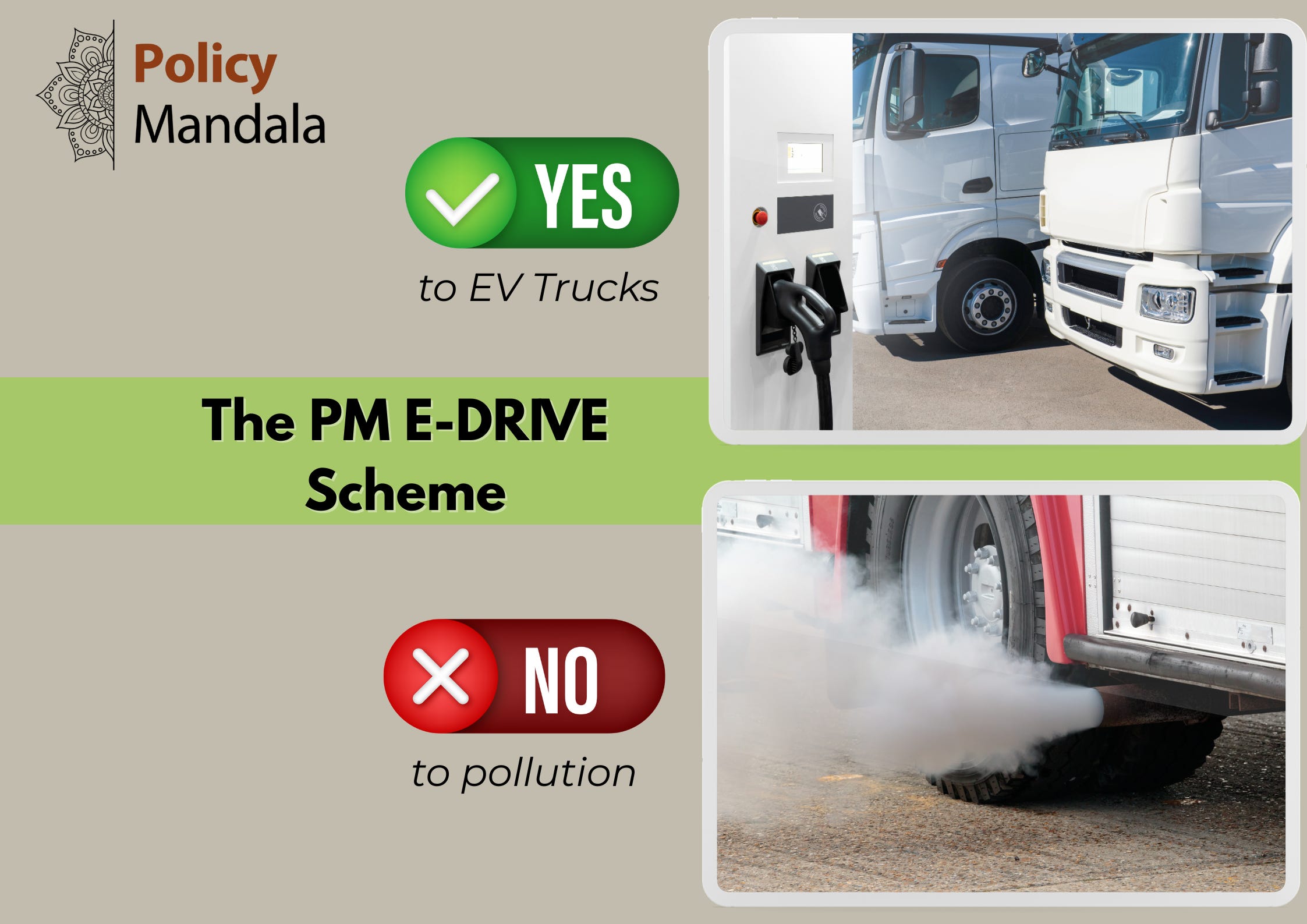
Last week, under the PM Electric Drive Revolution in Innovative Vehicle Enhancement (PM E-DRIVE) scheme, the Ministry of Heavy Industries rolled out its first-ever direct subsidy for electric trucks.
It’s not just an incentive. It’s a shift away from diesel and towards something cleaner, quieter, and long overdue.
And in this week’s Policy Mandala, we decode what this bold policy could mean for India’s economy, its environment, and its roads.
Let’s start with the basics.
The scheme offers a maximum of ₹9.6 lakh per vehicle for heavy-duty e-trucks in the N2 (3.5–12 tonnes) and N3 (above 12 tonnes) categories.
Here’s how the incentives stack up:
3.5–7.5 tonnes → up to ₹2.7 lakh
7.5–12 tonnes → up to ₹3.6 lakh
12–18.5 tonnes → up to ₹7.8 lakh
18.5–35 tonnes → up to ₹9.6 lakh
35–55 tonnes → up to ₹9.3 lakh
Note that these are based on a ₹5,000/kWh subsidy cap, with a maximum of 10% of the ex-factory price. In short: the heavier the truck, the bigger the battery, the higher the incentive.
But to unlock these incentives, there's a catch: the buyer must scrap an old diesel truck. That truck must be registered in their name and meet certain age and registration conditions.
So how many trucks are we then talking about?
For now, the government has earmarked ₹500 crore to support 5,600 electric trucks. Of these, 1,100 are allocated to Delhi alone. A decision driven by air quality concerns and the Centre’s direct oversight of the Capital Region.
But the number of trucks isn’t the real story here.
The real story is who benefits, who might hesitate, and where do the real challenges lie?
And over the next few minutes, we will unpack just that. From cost math and charging gaps to infrastructure, oil economics, and the policy signals still missing.
Let’s talk money. Because for most transporters, that’s what this decision comes down to.
Right now, a typical N3 e-truck costs ₹30 to ₹40 lakh. A diesel version? ₹15 to ₹20 lakh. Even with the maximum subsidy of ₹9.6 lakh, the gap is significant.
And there’s more.
Scrapping an old diesel truck costs ₹1–2 lakh through authorised centres, and that cost isn’t covered. It doesn’t increase the subsidy. It’s just an added expense.
So what’s the actual math?
Even after subsidies, an electric truck could cost ₹21–32 lakh. A diesel one? Still ₹15–20 lakh.
That’s a difference of ₹8–10 lakh upfront.
And that’s a lot to ask from a small fleet owner, which, by the way, is who runs most of India’s transport economy.
But hang on, because there is a brighter side to it.
According to recent studies, a diesel truck costs about ₹15.15 per km to operate, while an e-truck clocks in at ₹13.96 per km. That’s a saving of ₹1.19 for every kilometre.
Now scale that over time.
If the cost difference is ₹9 lakh, a transporter would need to drive around 7.5 lakh kilometres to break even. That’s about five to six years of long-haul operations.
And remember, that’s without assuming diesel prices go up or cities start restricting fossil-fuel trucks more aggressively.
So yes, the savings are built in, you just have to keep moving.
But here’s the twist.
You can’t drive an e-truck without a charger. And this is where India may hit a real bump in the road.
Right now, India has around 25,000 public EV chargers. But most are designed for scooters and cars. High-capacity megachargers for trucks? Still rare. Still expensive. Still being tested.
Yes, some early pilots are running along the Delhi–Mumbai Expressway and the Bengaluru–Chennai corridor. But across most freight routes, charging infrastructure is still missing. And that changes everything.
Without a charging network, e-trucks don’t stall, they overcompensate.
Operators are forced to install oversized battery packs just to avoid getting stranded. These packs can raise truck costs by 35–40%. With battery prices still at ₹12,000–₹15,000 per kWh, that’s a steep premium for infrastructure that doesn’t exist.
Bigger batteries also mean heavier trucks, lower payloads, and capital that’s locked in lithium instead of logistics. They make it more expensive, more uneven, and more frustrating.
That’s exactly why the government is starting with a few key freight routes like Delhi–Jaipur, Pune–Aurangabad, and Indore–Bhopal, where truck-friendly charging stations are being planned every 40 to 60 kilometres.
It’s a smart beginning. But it needs to move faster than the trucks it aims to support.
Because the urgency is real.
Trucks aren’t just vehicles, they’re India’s most powerful logistics engine. Over 70% of all freight in India moves by road. Railways handle bulk cargo like coal and cement. But everything else like groceries, milk, e-commerce, machinery, moves on trucks.
And that movement isn’t cheap.
India’s logistics sector consumes 13–14% of our GDP, almost twice the global average. That inefficiency makes our exports costlier, crowds our cities, and clogs our highways.
Electric trucks won’t fix all of this. But they can definitely lower costs, reduce diesel imports, and cut pollution, if done right.
And that brings us to where India’s biggest opportunity lies.
Because the highways are already here.
The Delhi–Mumbai Industrial Corridor spans over 1,500 km and accounts for nearly 20% of India’s industrial output. The Golden Quadrilateral connects Delhi, Mumbai, Chennai, and Kolkata, moving a massive share of national freight. The 350-km Bengaluru–Chennai stretch links two booming manufacturing hubs.
These are not just highways. These are corridors of scale. And they’re ready for an electric transformation.
Take the Eastern Peripheral Expressway around Delhi.
It already diverts truck traffic, has toll automation, and the structural space for megachargers. It could be a national model for EV-friendly freight corridors.
In short: we’ve built the skeleton. India has Dedicated Freight Corridors. It has Unified Logistics Interface Platform (ULIP) for real-time cargo tracking. It has multi-modal logistics parks. And an EV-friendly Bharatmala network is underway.
But now we need the muscle to match them with – charging stations, smart incentives, and green logistics standards.
So far, we’ve talked roads, trucks, and batteries.
But there’s one more reason electric freight matters, and it's spelled D-I-E-S-E-L.
Freight trucks guzzle a huge chunk of India’s diesel.
We import 85% of our crude oil. That’s billions of dollars leaving our economy every year.
Even if just 10% of trucks go electric by 2035, we’d carve a real dent in that oil bill.
That’s not just a climate win. It’s an energy security win.
But here’s the catch!
As soon as the announcement came, we looked for the follow-through.
Where’s the deployment calendar? Where’s the Make in India roadmap? Where’s the Phased Manufacturing Programme (PMP) that links subsidies to local manufacturing?
But… nothing.
No localisation targets. No Original Equipment Manufacturer (OEM) delivery expectations. No PMP.
Without these, manufacturers can’t invest. Buyers can’t plan.
And the scheme risks becoming just another pilot.
Sure, public firms like SAIL have pledged 150 e-trucks by 2027. But that’s still a distant milestone. And unless public and private players get clarity soon, the 2025–26 window may slip past.
So while this hasn’t been announced yet, here’s what we wish for:
First, let public-sector giants like SAIL, CONCOR, and FCI take the lead, just as EESL did with EVs for government fleets.
Second, we need a clear deployment timeline, localisation rules, and a PMP that ties subsidies to domestic production—this year.
Third, we need cities to plan low-emission freight zones, starting with curbs on diesel trucks during peak hours.
Fourth, we need a policy for India’s ₹60,000 crore truck component industry. One that helps suppliers and manufacturers shift toward EV parts with phased incentives and support.
Because someday, maybe not too far from now, India’s freight system will go net-zero.
And we won’t meet our climate targets just in negotiation halls.
We’ll meet them where it matters the most.
On our roads. And on our highways.
The team behind Policy Mandala has launched a 4-month policy program for professionals, the Policy Pioneers Program, in collaboration with IIM Raipur and the Public Systems Lab at IIT Delhi.
Know more about it here.
Book Mandala
In this section, we suggest a book to be read/listened to each week, for the inner policy enthusiast in you :)
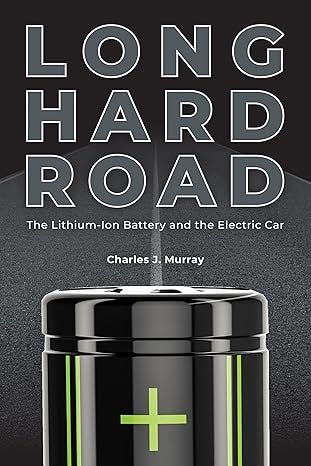
Book: Long Hard Road: The Lithium-Ion Battery and the Electric Car
Author: Charles J. Murray
About the Book
In Long Hard Road, author Charles L. Murray takes us deep into the messy, uncertain, and fascinating evolution of a technology that is now driving the world—literally. This is the story of the lithium-ion battery, told not as a miracle moment, but as a decades-long relay race between scientists, corporations, and unlikely champions across continents.
From early indifference to eventual dominance, the book traces the battery’s journey from lab benches to camcorders, laptops, and finally, to the heart of the electric vehicle revolution. The narrative culminates in how mainstream auto giants finally embraced lithium-ion as the battery chemistry that could turn electric cars from a curiosity into a commercial force.
Our Take
This book is a must-read for anyone trying to decode the electric truck push unfolding in India. As India dreams of electrifying its freight highways, this story offers vital lessons: that technology adoption is slow, often chaotic, and shaped as much by policy and corporate risk as by science. For policy thinkers, clean-tech entrepreneurs, and mobility researchers, this book delivers a compelling backstory on how the EV revolution was built—cell by cell, deal by deal.
Co-authored by Mrinal Rai and Aswathi Prakash.
Hope you liked today’s Policy Mandala!
We believe nation-building needs a community of changemakers—so we’re creating Bharat Mandala, an ecosystem for impact. Be part of our journey here!
Thanks for reading Policy Mandala! Subscribe for free to receive new posts and support our work.