
There’s always that one name from your childhood.
Maybe it was a girl in school who outran everyone at Sports Day. Or a boy in your neighbourhood who could twist a cricket ball like magic. Maybe it was you, until the world slowly told you that dreams like these don’t make it in India. Not unless you’re born rich. Or in the right city. Or into the right family that knows someone in a federation.
You never forget that feeling. Of being good. Of being seen. Of watching it fade.
That’s where we begin this week’s Policy Mandala. Because something rare is happening in India’s policy landscape. Something that just might decide how many more children grow up believing that sports is not a gamble, but a career.
The National Sports Governance Bill, 2025, tabled this monsoon session, is not imagined as a quick fix, but rather it aims to make a more fundamental shift: it writes into law the idea that every athlete deserves fairness, dignity, and a chance. Or at least that is the objective. Let’s explore the details to find out.
Let’s begin with why India’s sports governance needed a reset, what the new law brings, where it still falls short, and how other countries got it right long before we did. This is a story about ‘new’ law, but also about ‘old’ loss, of time, of talent, and of what could have been.
You see India is currently ranked number one in population, third in GDP (by PPP), and 71st in Olympic medal tally.
That gap is not just statistical, it’s systemic.
In the 2024 Paris Olympics, India sent 117 athletes and returned with just 6 medals. Meanwhile, the US, whose university sports system doubles as an Olympic nursery, sent 595 athletes and won 126 medals. China and the UK, despite much smaller populations, have consistently outperformed India by margins that force us to rethink our sports potential.
Like most cases, the burden of this ‘failure’ doesn’t lie with the athletes. It’s about the structure around them.
For decades, India’s sports governance has been plagued by dynastic control, opaque selections, budget leaks, lifetime presidencies, and a culture where politics often trumps performance. Today, over 350 cases involving athletes, federations, and selections are currently pending in courts across India. That’s almost three times the size of India’s entire Olympic contingent being left in limbo, waiting for someone to decide their fate. In sports, where careers peak in a handful of years, a delay like this doesn’t just hurt, it ends futures.
The new Bill changes this on paper and perhaps, if implemented well, in practice.
First, It sets up a National Sports Tribunal, a quasi-judicial body with powers of a civil court, meant to address all sports-related disputes.
Second, it makes independent Ethics and Election Panels compulsory in every federation for the first time, ensuring free and fair leadership transitions and rooting out conflicts of interest that have long plagued Indian sports bodies.
Third, It imposes term limits and age caps on office-bearers, ending the era of lifetime leadership.
Fourth, It brings athletes into governance, with at least 25% seats reserved for sportspersons, and makes RTI compliance mandatory for all publicly funded bodies.
And fifth, It also introduces annual grading of federations based on transparency, inclusion, athlete welfare, and performance. These grades will determine funding and privileges. For the first time, bad governance might actually cost something.
In many ways, this sounds like a quiet revolution in the making.
India has never had a binding law for sports governance before. The 2001 National Sports Policy was only a guideline, and the 2011 Sports Code barely enforceable. This Bill finally gives legal teeth to long-pending demands: clear rules, fair elections, independent audits, and enforceable athlete rights.
But the harder question is - will it work?
Because a law is only as good as the implementation, and the implementation is only as good as the will to implement it. After all, in a democracy, political will precedes any action.
Take the Tribunal, for instance. It promises fast-track resolution, but stops short of committing a window. Will it deliver decisions before an athlete’s window of opportunity closes? Will NSFs actually comply with Safe Sport norms, or will they treat them like another tick-box? Will putting athletes in executive committees change the culture of federations being a minority in those boards, or will it tokenise their voices?
And then there are the structural questions the Bill does not answer.
Firstly, if athletes are now part of decision-making bodies, are we also training them in sports law, management, governance principles, and financial oversight? Or without capacity-building, are we setting them up to fail?
Secondly, while the law mandates welfare frameworks, it does not specify pension schemes, post-retirement skilling, or job security. Today, many retired athletes, some of them international medalists, struggle to find dignified livelihoods. Sports quota jobs, once a reliable cushion, are dwindling. The CBIC and other government bodies now recruit athletes only at Group C and D levels. Even private sponsors like TATA or Indian Oil have scaled down, with contracts tied more to form than long-term welfare.
And we must remember why the government is pushing this Bill with such urgency: India has already submitted a Letter of Intent to host the 2036 Olympics, and a committee is in place to overhaul funding norms in preparation for it.
The stakes could not be higher. Which is why we believe the government must go further:
First, strengthen the presidency rule further not just with term limits, but by explicitly barring family members from succeeding each other. This will break the dynastic control that has hollowed out federations for decades.
Second, grant athletes veto power on a few critical decisions such as changes in selection criteria or disciplinary actions, where conflicts of interest have historically undermined fairness. This would make athlete representation meaningful, not symbolic.
Third, while the Bill already mandates CAG audits and RTI compliance, it should go one step further by requiring public disclosure of player selection scores and budget allocations. Genuine scrutiny can only happen when this information is visible and comparable.
Fourth, adapt the Capacity Building Commission’s accreditation system used for Civil Service Training Institutes (CSTIs) to National Sports Federations. An independent accreditation mechanism can assess and rank federations on governance, transparency, and athlete welfare, creating a real incentive for reform.
That’s what India needs. A system where sports is not a detour, but a legitimate path with structure, support, and second chances.
Private initiatives like Olympic Gold Quest (OGQ), founded by former India hockey captain Viren Rasquinha along with other celebrated athletes like the billiards legend Geet Sethi, Prakash Padukone, and Viswanathan Anand among others, the organisation has worked to support athletes where the system often falls short. OGQ provides world-class physiotherapy, coaching, analytics, and nutrition to elite sportspersons. Many Indian Olympians, from PV Sindhu to Lovlina Borgohain, have benefited from its support. But OGQ is still a non-profit with limited reach, and its work, while vital, cannot substitute for the systemic reforms that only strong governance can deliver.
A nation of 1.4 billion cannot depend on goodwill alone.
And that’s why this Bill matters. For the first time, athletes in India have enforceable rights—not just dreams. A player wrongly dropped from trials can appeal to a Tribunal. A young girl facing harassment can turn to a Safe Sport system. A whistleblower in a corrupt federation can seek protection without fear.
But rights on paper are only the first step. Does the system truly support the sportsperson?
That is the real test.
And it begins not in Parliament, but in the next playground where a child wonders if sports is worth the risk.
Book Mandala
In this section, we suggest a book to be read/listened to each week, for the inner policy enthusiast in you :)
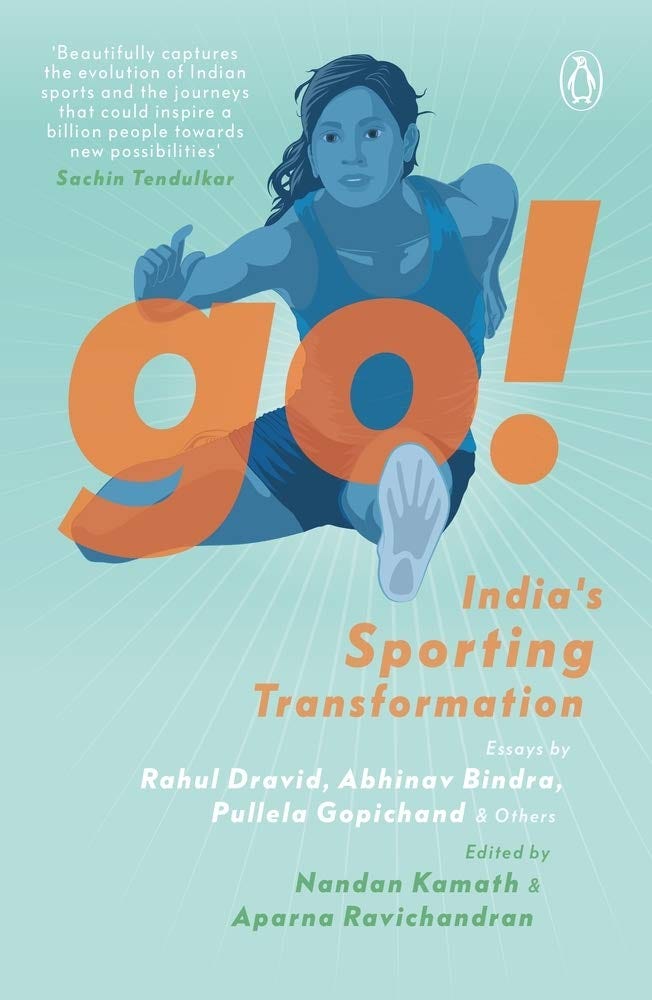
Book: Go!: India’s Sporting Transformation
Author: editors Nandan Kamath and Aparna Ravichandran
About the Book:
Go!: India’s Sporting Transformation, brings together an extraordinary collection of essays from India’s top athletes, sports administrators, and thinkers—including Abhinav Bindra, Rahul Dravid, Aparna Popat, and Pullela Gopichand. The book traces how a country once starved of sporting success is now producing champions in multiple disciplines, while also confronting deep structural challenges in talent pipelines, governance, and infrastructure.
From homegrown leagues drawing global stars to grassroots athletes battling odds for a shot at the podium, these essays capture the scale and complexity of India’s sporting revolution. The narrative doesn’t shy away from hard questions on systemic failures, making it both celebratory and unflinchingly honest.
Our Take:
This book is essential reading for anyone seeking to understand the reforms Indian sport truly needs. As the National Sports Governance Bill 2025 takes shape, Go! offers rich context on why athlete-first systems and accountable institutions are critical for India’s sporting future. It is as much a roadmap as it is a reminder: medals are not just won on the field, but built long before, in the corridors of governance.
Co-authored by Mrinal Rai and Aswathi Prakash.
Hope you liked today’s Policy Mandala!
We believe nation-building needs a community of changemakers—so we’re creating Bharat Mandala, an ecosystem for impact. Be part of our journey here!
Thanks for reading Policy Mandala! Subscribe for free to receive new posts and support our work.