
In a quiet village in Bihar, Ramprasad, an agricultural labourer, reaches the Fair Price Shop (FPS) to collect his family’s monthly ration. The season has been harsh for them, and the grain is their only cushion.
But the sack feels lighter than it should.
Five of the 25 kilograms meant for his family have disappeared somewhere in transit within the Public Distribution System (PDS). For the system, it is merely a leakage, but for Ramprasad and his family, it means sleeping with an empty stomach.
Ramprasad is not alone. Nearly 22.1% of India’s PDS rations are siphoned off or diverted, leaving countless families wanting for food as every 3 in 5 Indians depend on the same for meeting their basic needs of food and nutrition.
Earlier this month, the government unveiled a major overhaul of the PDS system with a new umbrella scheme to solve the issues of leakages and ensure systemic accountability, named SARTHAK.
Today, in this edition of Policy Mandala, we will talk about how the government is trying to solve this crisis through the use of Artificial Intelligence in the downstream logistics of this Public Distribution System through SARTHAK.
SARTHAK (Scheme for Assistance in Ration Transport and Handling-Income with Automation) in PDS, is a newly consolidated, technology-driven umbrella welfare program with a massive outlay of over ₹ 25,500 Crores over the next five years.
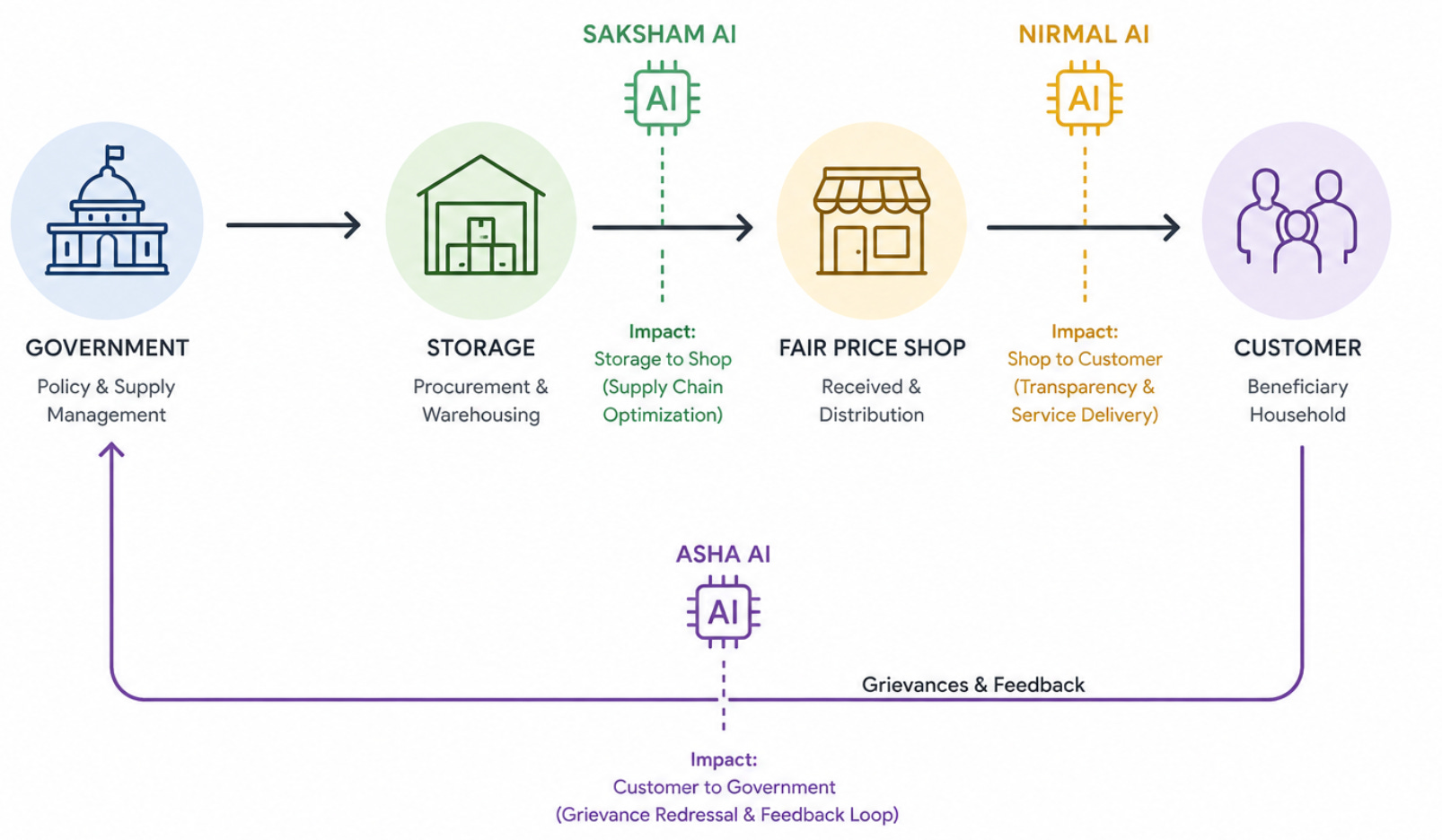
While integrating existing schemes, it introduces three new AI-driven initiatives to cover and reduce leakages in the entire gamut of downstream logistics, including transportation, last-mile delivery, and public grievances.
The first, SAKSHAM AI is a unified, interoperable PDS architecture aimed at ensuring last-mile service delivery. The second, NIRMAL AI is a real-time registry that tracks and verifies PDS beneficiaries. The third, ASHA AI is a regional language, AI based IVRS for beneficiaries.
These three form the core AI backbone of SARTHAK-PDS. One solves leakages, the second fake and misplaced beneficiary records, while the third grievances. If they can deliver the commitment, it is likely to be both a policy and political win for the government: after all, this is one of the few policies that have survived for more than 6 decades.
India’s PDS is not one simple pipeline. It involves central procurement, storage, state-level transport, local distribution, beneficiary databases, Fair Price Shops, grievance mechanisms, and multiple layers of administration. When these systems do not speak to each other properly, leakages become harder to detect and easier to hide.
To begin, the most important highlight of SARTHAK is its integration of all existing PDS systems in India at both the state and national levels. And this matters.
Firstly, when a beneficiary’s record exists across disconnected systems related to PDS, no single authority can see the full picture. SARTHAK’s unified architecture means a discrepancy anywhere in the chain becomes visible in real time.
The second impact is related to the Indian PDS’s biggest nightmare, Ghost Beneficiaries, people who appear on records, take rations in real time on systems but do not exist on the ground. Tonnes of this ration makes its way every month across the borders to Bangladesh and Nepal.
With SARTHAK, its component, the NIRMAL AI system will drive AI analytics across inter-ministry records such as the CBDT, MoRTH and civil registration records, and records in the SMART-PDS system, effectively eliminating this menace. AI is best suited for this task due to its inherent capability of detecting patterns in large datasets.
The second highlight of SARTHAK is tracking every mile of the PDS supply chain. This is enabled through SAKSHAM AI, which integrates AI QR code traceability and GPS-enabled vehicle tracking with the AI ecosystem, effectively creating a chain of custody that cannot be broken.
When a truck leaves an FCI godown with 10 tonnes and arrives at the FPS with 9.3 tonnes, the system should flag the gap. Right now, that gap is invisible. QR code traceability with AI means each consignment has a verifiable chain of custody at every handoff point.
This addresses nearly 10% of India’s PDS leakage. However, how will the remaining 10% be taken care of?
This leakage happens at the Fair Price Shop level. Probably the FPS shopkeeper himself siphoned off the grains, but Ramprasad has no redressal mechanism. Already in a hand-to-mouth state, Ramprasad cannot afford to go door to door at government offices.
This is where the third part comes into play.
Ramprasad can now simply dial a number, speak out his grievance in his vernacular language, and done. The grievance will be updated on the PDS system before the relevant official, and also in the larger database against the shopkeeper. All this, thanks to ASHA AI.
The government exchequer is also to benefit.
With annual food subsidy expenditure exceeding ₹2 lakh crore, even a 10% improvement in delivery efficiency through better storage, transportation, and beneficiary management could save the exchequer around ₹20,000 crore every year.
However few critical questions remain unanswered or absent from the public discussions.
Is this move backed by a clear executionary pathway, or is it merely another gimmick in the age of AI?
Will SARTHAK change the face of India’s PDS system, or will it just be another of the various schemes launched by the government ?
Firstly, there is no detailed allocation profile in the SARTHAK scheme specifically for its AI components. The ₹25,530 crore headline figure is largely a repackaging of existing spends. A large portion is likely to go to the state agencies as financial support for existing regular spends.
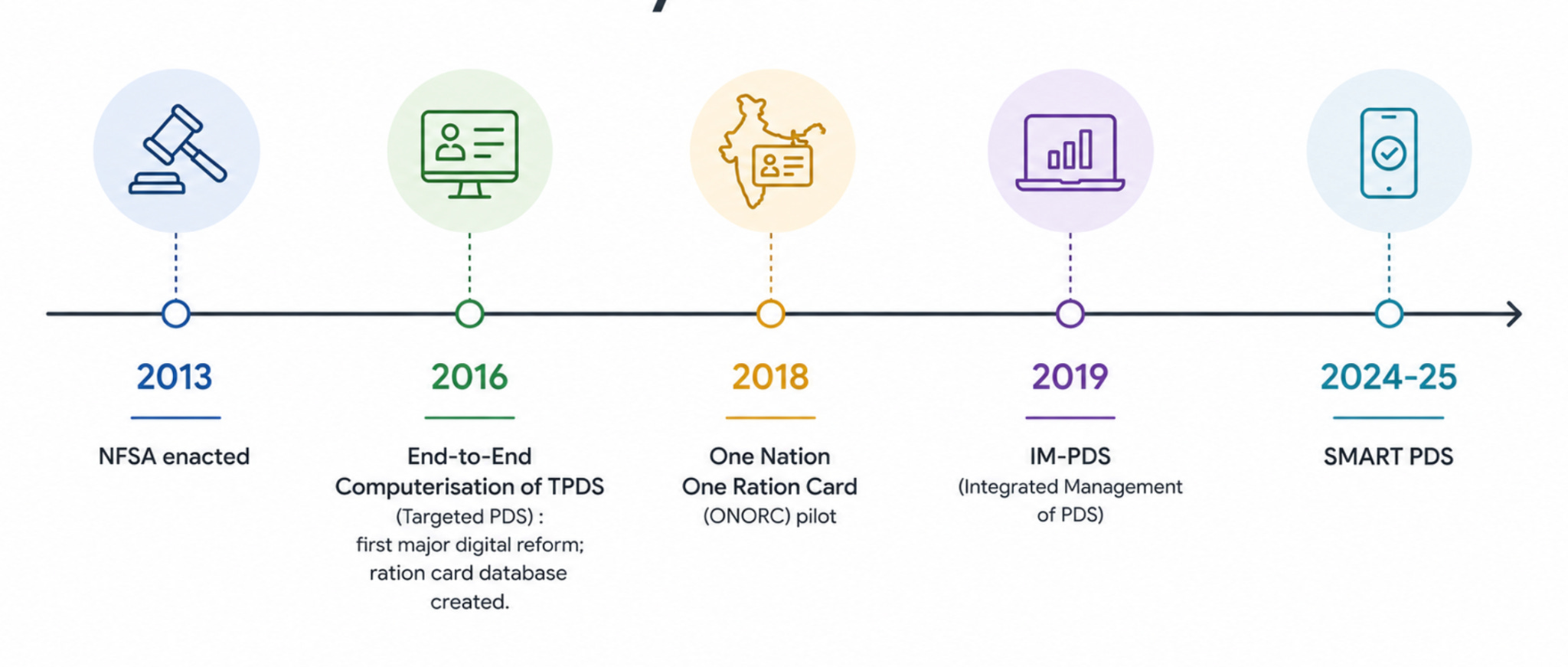
Secondly, the tender for the scheme will, in all probability, be awarded to NIC. SARTHAK is not the first digital move in India’s Public Distribution System. SMART PDS, which is the existing precursor to SARTHAK and the SMART PDS 2.0 portal were also delivered by NIC. The inference is clear.
And NIC’s history of delivering complex, AI-driven systems at welfare scale remains unproven. While capability exists on paper, there has not been any demonstration till date.
Thirdly, AI is inherently biased in Data.
AI models learn from historical data. If legacy PDS databases contain inaccuracies or reflect existing administrative biases, AI may simply automate those biases.
If SARTHAK uses historical PDS transaction data to flag anomalies, areas involving vulnerable groups such as migrants, tribal communities, or households with irregular purchasing patterns could face disproportionate scrutiny unless algorithms are independently audited.
Fourthly, the ability of the government to execute a robust data management framework with complex systems is probably the biggest concern of the lot.
A centralized AI-enabled PDS platform could become an attractive target for ransomware attacks, database breaches, manipulation of beneficiary records and supply-chain cyber intrusions.
And NIC’s track record has not been particularly impressive nor has it been one of India’s databases. The ICMR Data Leak of 2023 is a case in point where a complex, interconnected and distributed data system was breached, exposing datasets with more than 100,000 records to malicious entities.
To add to the troubles, the recent CBSE case draws even more concern. Not only did the government fail on vendor procurement, but also exposed its data storage and access vulnerabilities.
There is no guarantee that things won’t go the same route again. And with a data of over 80 Crore people at stake, things look scary.
While the idea is good and the proposed components are well thought of in terms of technical design and the flaws they target, the policy is on shaky grounds when seen from the lens of data management, technical expertise and funding and implementation modalities.
A scheme that repackages existing spends, outsources technology to an unaccountable agency, deploys AI without audit mechanisms and concentrates data without adequate protection, is not a transformation of India’s food security architecture.
It is an elaborate announcement wrapped around a system that continues, in its essential character, unchanged.
What the scheme needs is a medicine that will cure nearly every announced policy in India, a detailed plan of implementation and financial commitment with its announcement. And with it, a robust way to actually design these systems with a transparent and effective tendering mechanism.
And with all this, NIC will need to develop indigenous capabilities to develop such systems at scale.
In the meanwhile, we can only adopt a wait and watch approach to see whether the scheme ends up revolutionizing the support system of millions or ends up as another of the government’s rebranding exercises that end up in the cold storage.
All this so that people like Ramprasad can finally get their due.
Co-authored by Samridh Joshi & Avdhesh Pathak
