
Thirty-year-old Gauri is washing dishes at her home in a village near Pune. It is 2024, Maharashtra is in election mode, and she has decided to vote for the Mahayuti alliance, partly because it has promised her ₹1,500 every month under the Ladki Bahin Scheme.
She is not alone. The Ladki Bahin Yojana turned a recurring unconditional cash transfer to women into a powerful electoral promise and helped the ruling alliance secure a decisive victory.
A later verification exercise removed 92 lakh beneficiaries, after an estimated ₹14,000 crore had already been transferred to their accounts.
Cash transfers are not new to India. Governments have used pensions, maternity benefits and targeted assistance for decades. What is new is the rapid rise of large, recurring and largely unconditional transfers to women, often announced close to elections.
These schemes can provide immediate relief and greater financial control. But they also place a heavy burden on state finances, test administrative systems, and raise a harder question: are they instruments of welfare and empowerment, or increasingly tools of electoral competition?
Cash Transfers reach over one-fifth of India’s women today, and this is why we chose to explore them in today’s Policy Mandala.
Before we analyse unconditional cash transfers, let us briefly understand what these schemes are and how they evolved in India.
Governments often provide cash assistance to support particular groups or encourage specific social outcomes. This assistance can either be conditional or unconditional. A conditional transfer is paid only when a specified action or milestone is completed, such as giving birth in a registered health facility. An unconditional transfer, on the other hand, is not linked to any target.
India’s modern cash-transfer journey began with Haryana’s Apni Beti Apna Dhan in 1994 and the National Social Assistance Programme in 1995. Conditional transfers later expanded through Janani Suraksha Yojana and Dhanalakshmi, while Direct Benefit Transfer, introduced in 2013, made it easier to deposit benefits directly into bank accounts.
These schemes were politically valuable, but they were generally introduced as programmes tied to specific welfare outcomes.
The modern wave began with Assam’s Orunodoi scheme in 2020 and soon spread through programmes such as West Bengal’s Lakshmir Bhandar, Madhya Pradesh’s Ladli Behna, Karnataka’s Gruha Lakshmi and Maharashtra’s Ladki Bahin.
This marked an important shift. Transfers were increasingly announced close to elections, while parties included them in manifestos. From incidental political value, the scenario shifted towards political promises.
While unconditional cash transfers have turned into electoral competition today, the real question is whether these schemes can provide meaningful support to women while remaining fiscally sustainable and administratively doable or whether electoral urgency weakens their design.
To understand that tension, we must first ask what these transfers actually achieve.
If designed well, cash transfer schemes can lead to improved social outcomes and create a multiplier effect. A study by SEWA1 and UNICEF in Madhya Pradesh2, found that unconditional monthly transfers improved food security, nutrition, healthcare use, school attendance, savings and entrepreneurship.
For women, receiving money directly can reduce dependence on other family members and increase control over everyday decisions. SBI’s research on the Ladli Behna scheme in MP found signs of incremental savings and greater use of formal bank accounts among beneficiaries. This leads to increased labour-force participation and weakened restrictive norms around women’s work.
The benefits may extend to children and nutrition as well. Evidence suggests that greater female control over household resources improves children’s health outcomes, and better diets and lower malnutrition among girls.
However, the gains from these schemes are often weakened by their fiscal design. In 2025–26, twelve states were expected to spend about ₹1.68 lakh crore on unconditional cash transfers to women, a sum nearly 0.5% of India’s GDP. Six of these states were already projecting large revenue deficits. The Economic Survey warned that such schemes could shift expenditure away from other infrastructure and social sector investments, producing a strong opposite effect to the idea of such schemes.
The pressure rises further when parties begin competing over the amount promised.
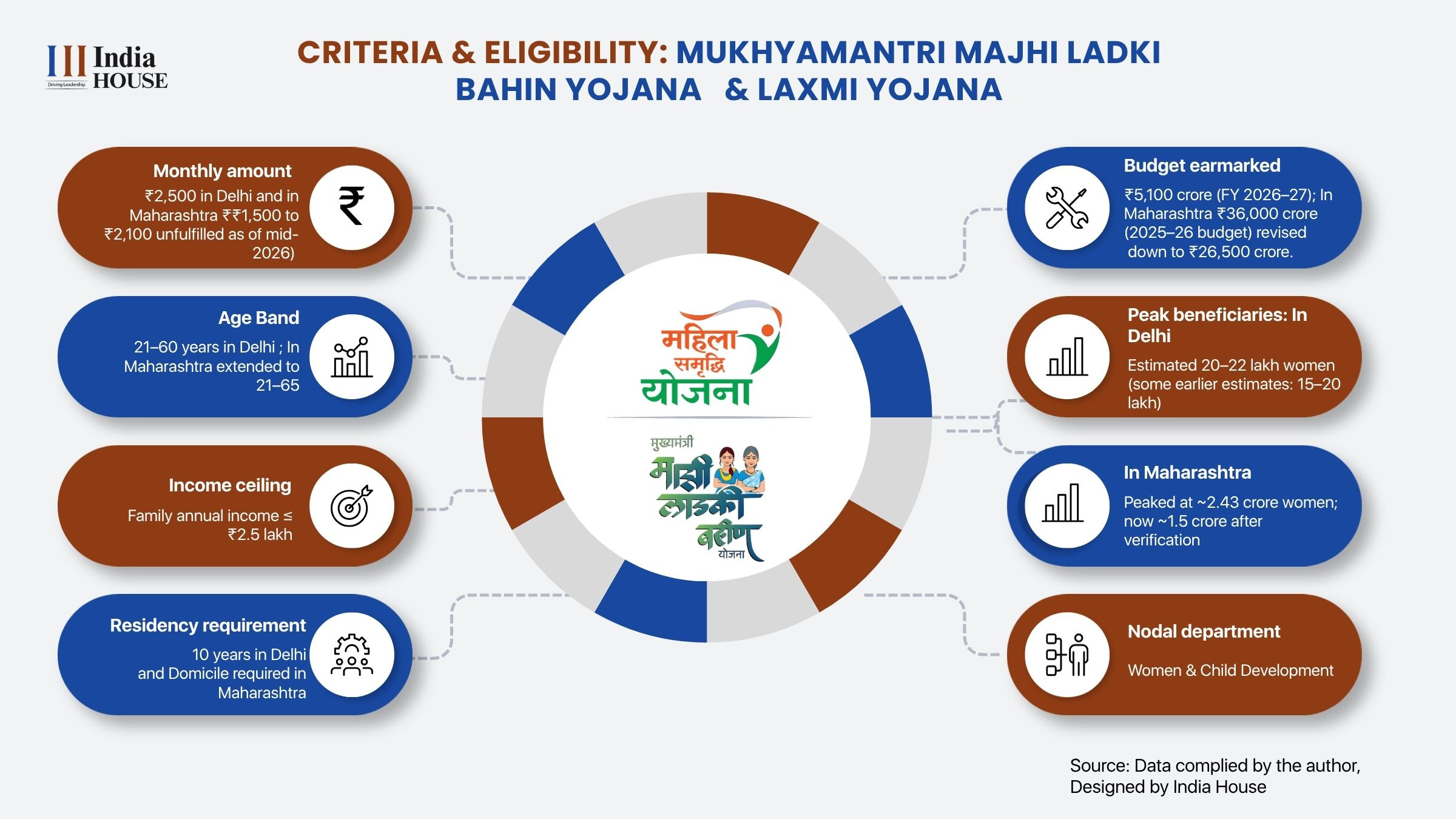
Take the case of Maharashtra itself, where the promise of ₹1,500 a month was followed by promises of ₹2,100 or even ₹3,000. Similar patterns were seen in states like Delhi. Cash transfers often turn from the agenda of women development into nasty electoral bidding wars.
What’s worse is that these figures are rarely tied to any clear estimate of how much cash is needed to improve nutrition, savings, employment or women’s agency. The amount is therefore shaped less by a measurable welfare outcome and more by what rival parties have already offered. As this bidding escalates, the fiscal cost rises even when the social return remains uncertain.
The larger weakness lies in policy design. Governments often try to cover the widest possible group from the start, without first testing eligibility rules, verification systems or grievance mechanisms. Maharashtra’s Ladki Bahin scheme enrolled about 2.43 crore women, only to remove 92 lakh after later verification.
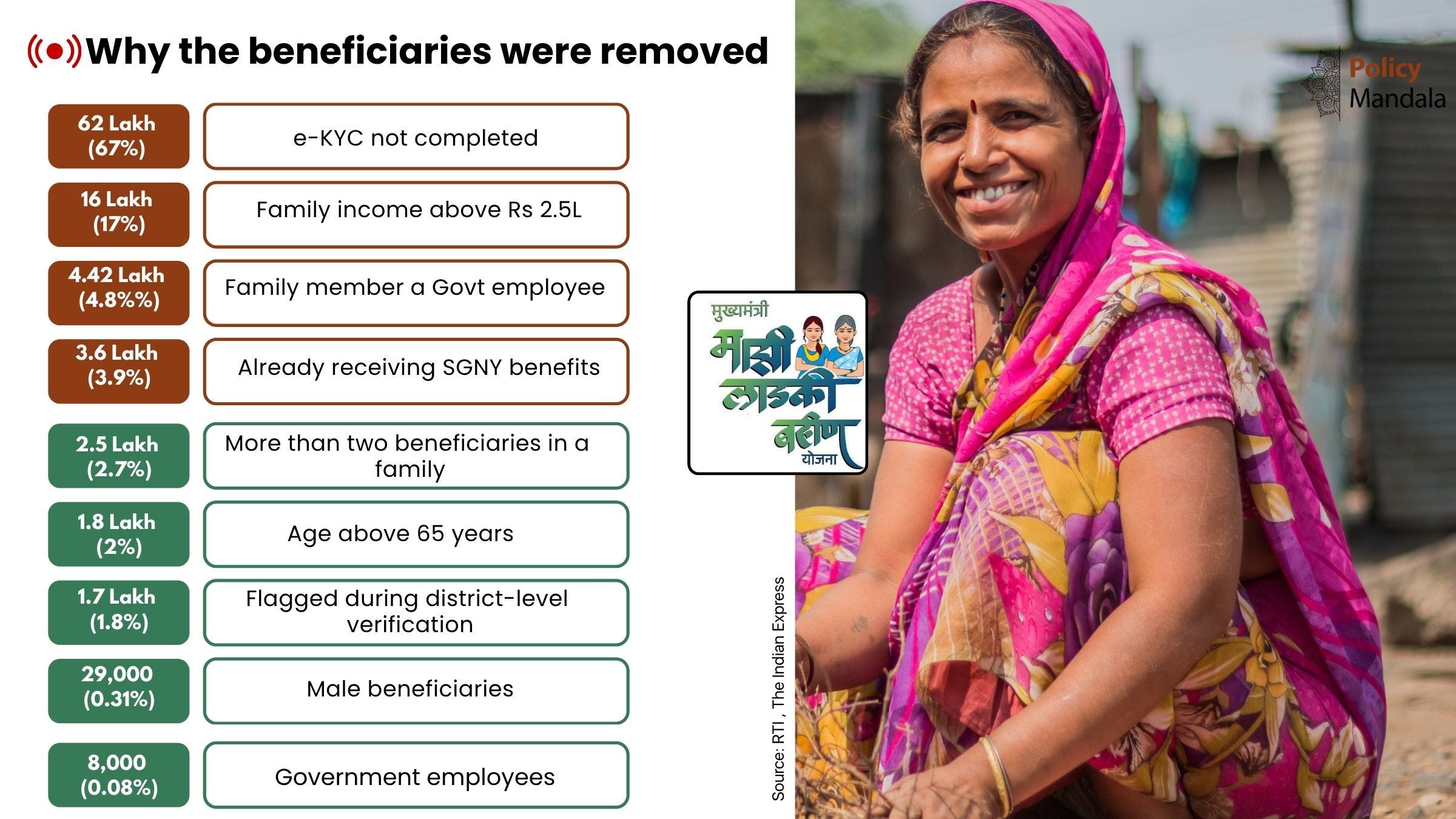
Verification then becomes a post-facto clean-up, leaving room for duplicate records, ghost beneficiaries and genuine women being excluded over documentation failures. At the same time, success is measured through money spent and accounts credited, while outcomes such as greater financial control, better nutrition or reduced distress are rarely evaluated independently.
So, where are we heading?
Cash transfers to women are unlikely to disappear. Their political appeal is too strong, and their welfare value is too real. What can change is the way they are designed.
Two broad principles can help improve the policy design of such schemes. The first is incremental expansion. Begin with a clearly defined group, test the databases and grievance systems, study who is being missed, and only then widen coverage. The second is rigorous impact assessment, which may be achieved through techniques like Randomised Control Trials.
For women like Gauri, ₹1,500 may still mean medicines, groceries or a little more independence. But for the state, the same transfer raises harder questions about who should receive it, how much can be sustained, and what the money is actually changing. The challenge is not choosing between welfare and politics. It is designing a welfare policy strong enough to survive politics.
Authored by Samridh Joshi
References:

Nice