
You return home after a long day, switch on the lights and plug in your phone. The electricity powering your daily life may have begun hundreds of kilometres away, inside a coal mine in Jharkhand, Odisha or Chhattisgarh.
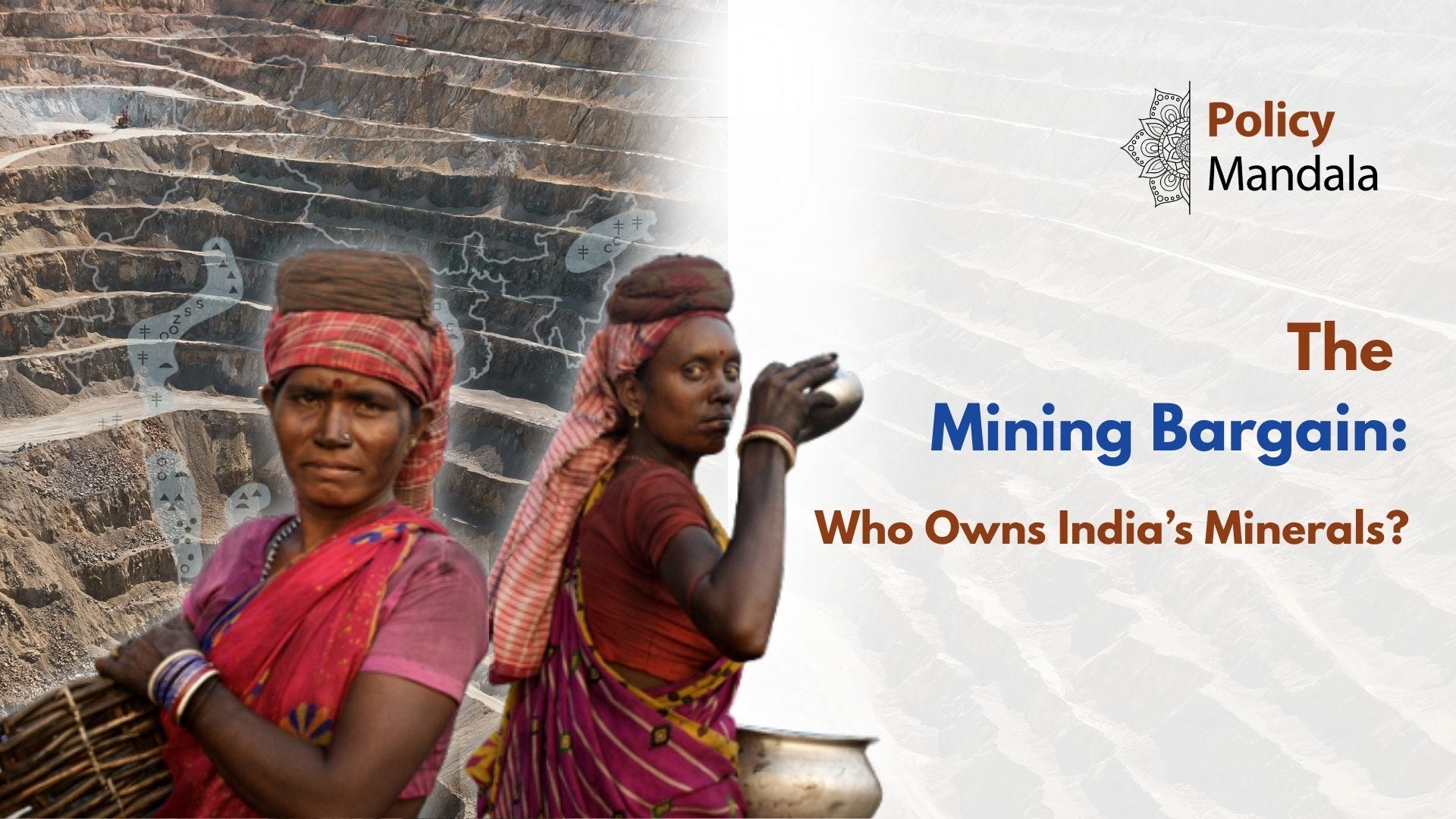
Coal is extracted, transported to power plants and converted into electricity that travels across states. But while electricity moves, the mine does not. The land, environmental and infrastructure costs remain concentrated where extraction takes place.
This creates a basic contradiction in India’s mineral economy: the resource is found locally, its value is realised nationally, but many costs of extraction are borne by the states and communities where mining takes place.
This raises a fundamental question: who should control mineral resources, who should tax their value, and how should the benefits be shared?
Minerals matter to both the Centre and states, but for different reasons. For the Centre, coal, iron ore, copper, lithium and other minerals are strategic inputs for energy security, manufacturing and growth. For mineral-producing states, mining is a critical source of revenue.
This has long created a federal tension. The Centre has sought greater consistency and predictability in mineral policy, while states have argued for greater autonomy over resources within their territory.
The debate has returned after Parliament recently passed the Mines and Minerals (Development and Regulation) Amendment Act, 2026, which restricts states from imposing certain taxes and levies on mineral rights, with the stated aim of improving fiscal predictability.
In this edition of Policy Mandala, we explore two questions: How can India balance state revenues with national mineral priorities? And can better exploration and extraction expand the mineral economy itself?
The story started with the Mines and Minerals (Development and Regulation) Act, 1957 which created the central framework for mineral development, including mining rights, royalties and extraction rules.
However, the question of how far states could tax mineral resources remained contested for decades.
In 2024, the Supreme Court gave a landmark judgement which stated that royalty paid under the MMDR framework was not a tax and held that states retained the power to tax mineral rights and mineral-bearing land. The judgment therefore shifted the balance towards greater state’s financial independence.
The 2026 amendment seeks to rebalance this equation by placing greater limits on state-level levies on mineral rights and mineral-bearing land, with the stated objective of creating greater predictability and uniformity in the mining sector.
So, how much fiscal autonomy should mineral-producing states have?
Both the Centre and states have strong arguments in this debate.
The Centre’s case is built around predictability. Mining projects require large investments and operate for decades. Companies make decisions based on expected royalties, taxes, auction premiums and regulatory costs. Sudden changes can affect project viability.
The Centre also argues that minerals serve the entire country. Coal powers electricity, iron ore feeds steel production, and critical minerals are becoming important for strategic industries. Higher extraction costs can eventually affect the wider economy.
It also points out that states already receive a large share of mining revenues, with around 90% of public revenues from mining flowing to states through royalties, auction premiums, District Mineral Foundation contributions, GST and other charges.
But for mineral-producing states, mining is not just an economic activity; it is a key source of government revenue. In Jharkhand, mining contributes around 8% of GDP, but accounts for about 85% of its own non-tax revenue. In Chhattisgarh, mining contributes around 6% of GDP but nearly 84% of its own non-tax revenue. In short, a major chunk of these state’s revenue depends on their mineral wealth.
And thus, for these states, mineral policy is also fiscal policy.
The debate is therefore not only about whether states will continue receiving royalties and auction revenues. It is also about how much control they should have over resources located within their territory, especially when they also bear the local costs of mining through pressure on land, infrastructure and administration.
There is, however, another side to this bargain: mining companies and consumers. If the cost of mining becomes too high, some deposits may no longer be viable and investment could slow down. At the same time, reducing mining costs does not automatically mean cheaper electricity or steel, as prices are shaped by competition and the broader market.
India therefore faces a difficult balance. Greater state autonomy can strengthen local decision-making but may increase uncertainty and costs. Greater national consistency can improve predictability but limit the flexibility of mineral-producing states.
But this debate will continue as long as India is only negotiating how to divide existing mineral wealth.
A more durable solution is to expand the mineral economy itself. More exploration, faster discovery of commercially viable deposits and quicker conversion of resources into operating mines can create additional value for both the Centre and states.
However, India’s mineral regime faces challenges at both ends of this chain. Since 2015, auctions have improved the process of allocating known deposits, but exploration requires a different kind of risk-taking: investing money to find resources that may never be discovered.
The Exploration Licence regime introduced in 2023 attempted to address this gap, but the incentive remains uncertain. Explorers who discover resources do not automatically receive mining rights; they participate in a later auction and receive a share of the eventual proceeds. Of the 13 Exploration Licence blocks offered in the first Central tranche in 2025, only seven were successfully concluded.
Even after discovery, a deposit must still move through approvals, mine development and production before it generates revenue. State outcomes show the importance of this final stage: in 2025, around 54% of auctioned blocks in Odisha were conversion of resources into producing mines, compared with 29% in Karnataka and 9% in Chhattisgarh.
India’s mineral challenge is therefore not only about who receives revenue. It is also about whether the country can create the conditions to discover, develop and produce more minerals in the first place.
Canada and Australia offer useful lessons. Their provinces and states have greater control over mineral development, while explorers have clearer pathways from discovery to production. India need not replicate these models, but they show that state flexibility, exploration incentives and a strong national mineral market can exist together.
A more balanced mineral framework would therefore require three shifts: predictable national rules with meaningful state flexibility, stronger incentives for exploration, and greater focus on converting discovered resources into producing mines.
India’s mineral challenge cannot be solved only by deciding who receives a larger share of existing revenues. A lasting solution requires protecting the interests of mineral-producing states while creating the conditions to discover and extract more mineral wealth.
While debates on federalism are unavoidable, the larger question remains whether India can make the mineral pie bigger in the first place.
Co-Authored by: Samridh Joshi & Avdhesh Pathak
Opportunity Alert!
India needs its best minds to solve its toughest challenges.
And that requires people with the intent and ability to act.
People who can understand systems, shape policy, work with stakeholders, and navigate implementation.
These are capabilities built through 3 things: Experience, Exposure and Practice.
Yet opportunities to build these capabilities through practice, not just theory, remain limited.
To help bridge this capability gap, India House’s flagship initiative Policy Pioneers Program, brings together: Practitioner insights, Real-world projects, Field exposure & Structured skill-building.
for professionals looking to engage more effectively with public systems.