
On 3 August 2026, the usually quiet campus of the Indian Statistical Institute (ISI) in Kolkata witnessed an unusual sight. Students and professors gathered in protest against a Bill introduced in Parliament hundreds of kilometres away.
The Indian Statistical Institute Bill, 2026 sought to modernise ISI’s governance. But students and faculty feared that it could weaken the autonomy that had helped the institution flourish. Meanwhile, in New Delhi, a Joint Parliamentary Committee was examining the Viksit Bharat Shiksha Adhishthan (VBSA) Bill, 2025, proposing a common regulatory framework covering IITs, IIMs and other leading institutions.
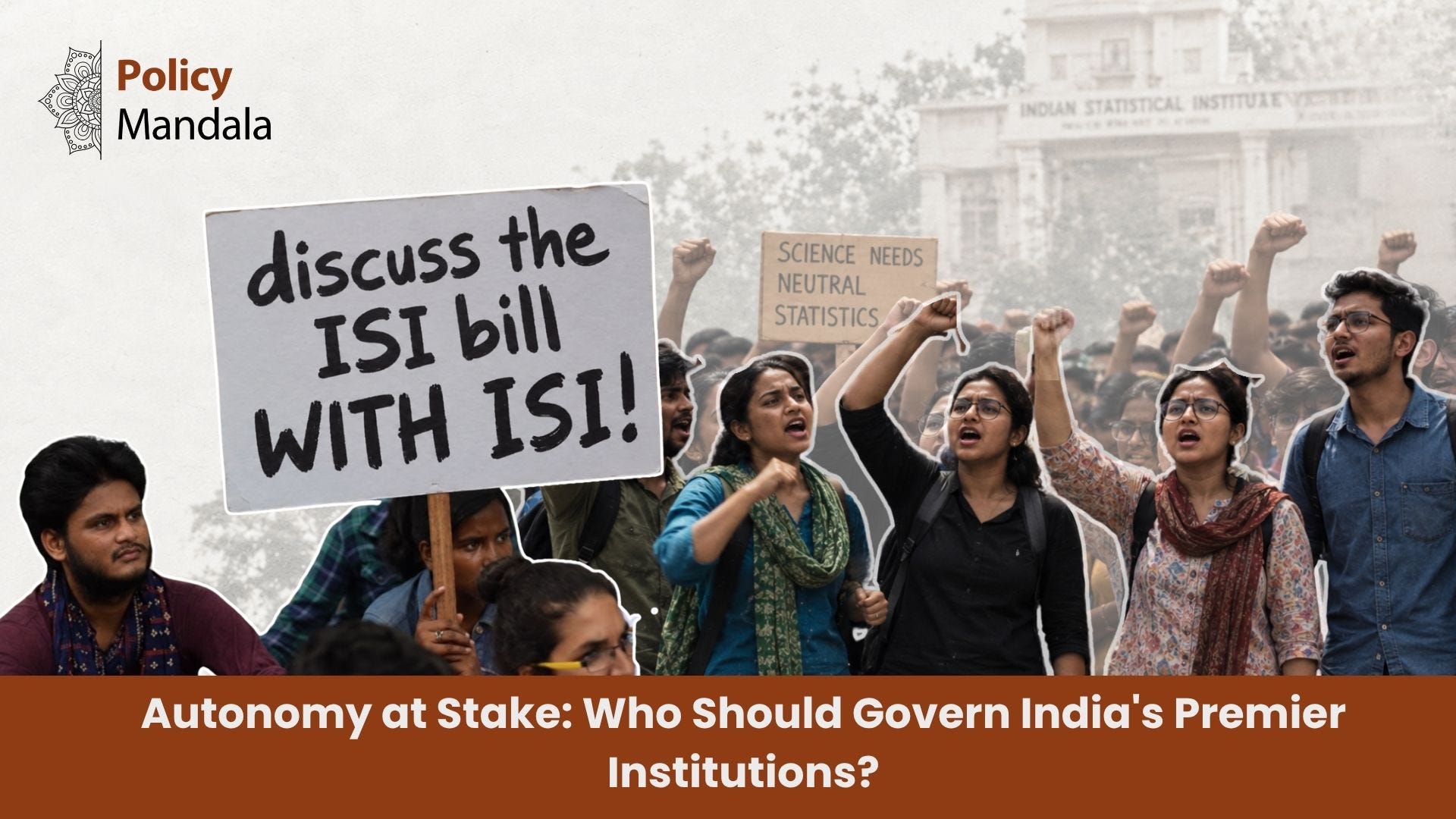
Together, the Bills suggest a shift towards greater regulatory uniformity and centralised oversight, raising concerns within academia.
Why should this matter beyond these campuses?
Over decades, these institutions have trained generations of talent, advanced research and strengthened India’s global reputation. Changes to how they are governed therefore carry consequences far beyond their gates.
In today’s Policy Mandala, we ask: What role do autonomy and governance play in building institutions of excellence, and how might these reforms change that balance?
To understand the stakes, we must first ask why IITs and ISI received special governance arrangements.
India’s early policymakers recognised that advanced education and scientific research needed room for experimentation, independent judgement and decisions led by experts rather than routine bureaucracy. The Statement of Objects and Reasons of the Institutes of Technology Bill, 1961, explicitly sought to “retain the individuality of the institutions”.
IITs received their own Boards and academic Senates, allowing them to pursue common national goals while developing distinct strengths.
A similar philosophy shaped the Indian Statistical Institute Act, 1959. Defending ISI’s existing autonomous character in Parliament, Prime Minister Jawaharlal Nehru argued that “scientific work should have certain latitude”. Accountability was necessary, but research could not be governed as another government department.
But what makes autonomy so important?
It allows those who understand a discipline to choose researchers, design courses and pursue questions whose value may not be immediately obvious. It protects independent findings, even when they challenge powerful interests. It also makes timely decisions possible: recruiting a promising scholar or backing an unconventional project need not wait on distant approvals. Financial freedom, too, allows resources to follow academic priorities.
Such autonomy cannot alone produce excellence, but it creates favourable conditions for talent, rigour and innovation. Globally, MIT, Stanford and Harvard demonstrate the value of institutional governing bodies and substantial faculty authority in academic matters.
If this approach has contributed to excellence, why are the rules now being reconsidered?
The government’s stated aims are straightforward. The VBSA Bill seeks to replace three regulators with a Commission and three Councils handling regulation, accreditation and standards. The ISI Bill seeks to update an older governance structure. Both promise greater coherence and efficiency.
Yet beneath these aims lies an important shift in who holds institutional authority.
ISI currently has a 33-member governing Council representing academics, institutional stakeholders and government nominees. The proposed Bill would replace it with an 11-member Board. Its Chairperson would be nominated by the President on the Central Government’s recommendation; government officials and members selected by the Chairperson would occupy several seats.
The Director’s appointment would require the President’s prior approval as Visitor. The Academic Council would remain, but the Board would hold substantial powers over institutional affairs.
Under VBSA, IITs and other Institutions of National Importance would also operate under an overarching regulator, even though their own Acts already establish Boards and academic authorities. The regulator could recommend reductions in autonomy or withholding grants for violations, while regulations intended to safeguard existing autonomy would require Central Government approval.
The Bills do not abolish academic freedom or explicitly authorise political interference in admissions. But changing who appoints leaders, defines compliance and controls key approvals can create openings for bureaucratic or political influence over recruitment, research priorities and, ultimately, institutional culture.
The risk is not merely slower decisions. It is the erosion of merit, independent judgement and confidence in the institutions themselves.
Publicly funded institutions cannot demand freedom without accountability. Nor should every existing governing arrangement be treated as beyond reform. The real question is where oversight should end and institutional decision-making should begin.
So, where should India draw that line?
First, who should govern? Boards must be led by people with academic, scientific and institutional expertise, selected through transparent, merit-based processes. Faculty and academic bodies should retain meaningful authority over appointments, admissions, curricula and research. Government should set broad public objectives and intervene directly only for serious breaches or exceptional circumstances. Oxford’s academic Congregation and MIT’s faculty governance illustrate how expertise can remain central to institutional decisions.
Second, who should judge quality? Strong internal reviews should be combined with independent peer assessment, public reporting and rigorous audits, not a growing chain of routine approvals. MIT’s accreditation by an independent agency and European quality-assurance principles show that institutional responsibility can coexist with external scrutiny. Quality should be judged by outcomes and integrity, not by how many permissions an institution secures.
Finally, can freedom survive without financial autonomy? Institutes should have greater flexibility to raise and deploy funds through alumni endowments, philanthropy, partnerships with industry and MSMEs, alongside predictable public support. IIT Delhi’s alumni-backed endowment provides an Indian precedent.
An IIT faculty member we talked to also suggested income-linked tuition repayment over a decade after graduation, with exemptions for those pursuing research or social-sector careers. Such options deserve careful design so that access remains equitable and academic priorities remain independent of donors.
India should therefore reconsider both Bills in their present form. Reform should emerge from sustained dialogue and broad consensus between government and academia, with clearer limits on external control and stronger mutual trust.
Institutions built to push the boundaries of knowledge need accountability, but they also need the freedom to do precisely that.
Authored by Samridh Joshi and Avdhesh Pathak
