
I live in Saket, Delhi, and last month, after heavy rainfall, the road outside my house was waterlogged. It was not surprising, but as a student of public policy, this time I wanted to raise a complaint.
Within minutes, I was confused. Should I complain to the Municipal Corporation of Delhi (MCD), which manages sanitation, the Delhi government’s Public Works Department, which maintains certain roads, or the Delhi Jal Board, which handles water and sewerage? Or perhaps the local MLA, who comes asking for votes every few years ?
I am sure millions of Indians living in our cities face similar confusion.
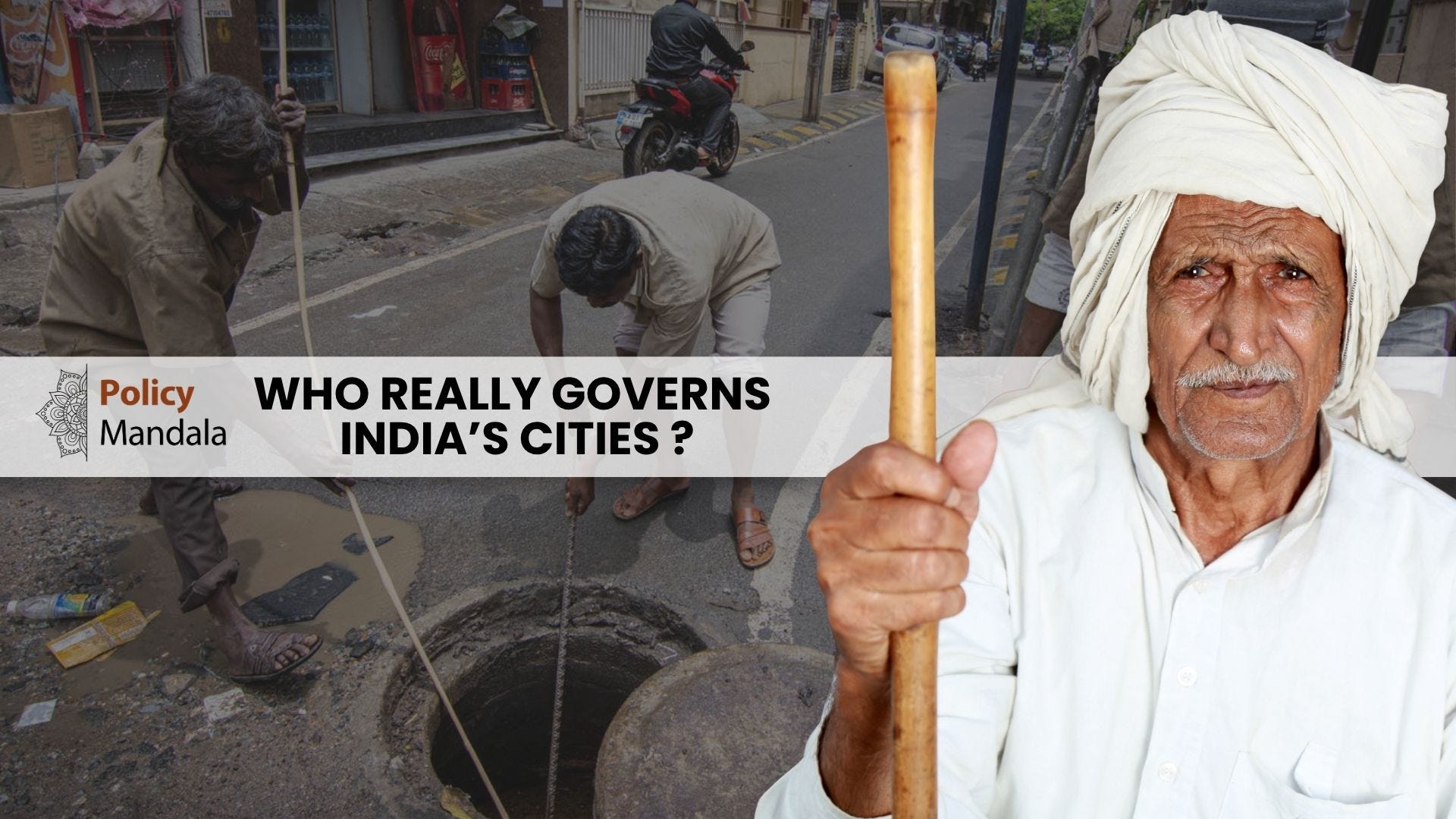
This led us to the question at the heart of today’s Policy Mandala: Who really governs India’s cities?
To begin, let’s look at three essentials of governance: finances, powers and institutions.
First, who controls public expenditure in a city?
Consider Bengaluru, one of India’s most discussed cities. A 2026 study by Janaagraha reconstructed approximately ₹38,455 crore of public expenditure in 2021–22, drawing upon records from 13 different public authorities.
The finding was interesting: only 20% of this expenditure was through the elected city government, while the remaining 80% was attributed to other public authorities, including state departments and specialised agencies.
Does this mean every service delivered in a city should be transferred to municipal bodies?
Not quite. As with most things in policy, the answer is complicated. Large transport networks, water systems and electricity distribution often extend beyond municipal boundaries and require specialised agencies.
Yet the question remains: If most public expenditure within a city happens outside its elected government, how much say does that government have in the city’s development?
To understand this better, let’s examine municipal finances.
Indian municipalities raise revenue through property taxes, service charges, parking fees, rentals and other sources. They also depend on transfers from the Centre and states.
The Reserve Bank of India’s 2024 study of 232 municipal corporations found that most could not meet their revenue expenditure through own-source revenues alone.
This creates a dependence on grants, whose amounts and timing can vary. For example, Bengaluru’s reported municipal revenue grants fell from ₹1,503 crore in 2021–22 to ₹632 crore in 2023–24, a decline of nearly 58%.
When such a significant source of revenue fluctuates, municipalities find it difficult to plan expenditure, particularly for infrastructure maintenance and services requiring sustained investment.
Now, imagine being the CEO of a large city.
You are responsible for several lakh people. You are expected to maintain infrastructure, manage services and resolve complaints. But you cannot independently determine much of your budget, recruit your own team or direct several departments responsible for implementation.
In such a situation, would you be able to deliver what everyone expects?
This is the dilemma confronting many Indian urban leaders, whom we call mayors. Their tenures further complicate matters.
Delhi’s mayor serves a one-year term, while Mumbai’s serves for two-and-a-half years. In both cities, substantial executive authority rests with municipal commissioners, while elected mayors have limited control over important administrative decisions.
But why do elected municipal governments have such limited authority?
The answer lies partly in how these powers were transferred.
Indian municipalities received constitutional recognition through the 74th Constitutional Amendment of 1992, which identified 18 areas of municipal responsibility under the Twelfth Schedule.
However, making this a reality largely depended on states. The transfer of Funds, Functions and Functionaries required state legislation and administrative decisions. Three decades later, municipalities may still be assigned responsibilities without receiving adequate authority, personnel or resources to fulfil them.
To add to this, Janaagraha’s research has documented an average delay of around 22 months in municipal elections in the cases examined.
This means India’s constitutional commitment to five-year local government has not always translated into uninterrupted democratic leadership. When elections are delayed, residents may lose their elected municipal representatives for extended periods.
And without elected leadership, urban India’s third tier of democracy loses an essential part of its accountability. The challenge becomes even more complex when we consider how India defines its urban areas.
Even defining what constitutes ‘urban’ is surprisingly complicated in India’s policy ecosystem.
The 2011 Census classified 31.2% of India’s population as urban. Yet the Economic Survey 2025–26 cites a satellite-based estimate suggesting that 63% of India was urban in 2015, using a different definition.
These figures are not directly comparable. The difference reflects how dramatically the measured extent of urbanisation can change depending on how we define an urban settlement.
You see, India distinguishes between two categories: statutory towns and census towns. Statutory towns have legally recognised urban administrations, while census towns meet demographic criteria but may still be governed through rural institutions.
Consider Delhi. The 2011 Census recorded 112 villages and more than 4.19 lakh people classified as rural within the National Capital Territory.
Anyone familiar with Delhi knows that many of these villages are deeply integrated into its urban landscape. Some are now surrounded by dense residential neighbourhoods, markets and commercial developments.
This illustrates how physical urban growth and administrative recognition do not always move at the same pace.
Here lies the larger problem: India’s urbanisation has advanced geographically, while public expenditure and authority remain divided institutionally.
So, what would give municipalities better control over their own development?
We see three core requirements.
The first requirement is predictable and flexible finances.
Kerala offers an example. The state uses a formula-based system to transfer resources to local governments, allocating 4% of State Own Tax Revenue to a General Purpose Fund and 6.5% to a Maintenance Fund, alongside development grants.
The Sixteenth Finance Commission has similarly recommended larger urban local-government grants for 2026–31, including a substantially increased untied component.
This is welcome progress. But financial autonomy requires predictable releases and the freedom to address local priorities. Much of this now depends on how states translate fiscal recommendations into actual transfers and powers.
The second requirement is professional administrative capacity.
NITI Aayog’s 2021 assessment found 42% vacancies in sanctioned town-planner positions across state and Union Territory planning departments.
Capacity-building efforts are underway. Under Mission Karmayogi, over 1.75 lakh urban local body officials have been onboarded onto the iGOT platform, with 154 curated courses. However, digital training alone cannot address practical training needs and staffing shortages.
We also need stronger urban training institutions, dedicated municipal service cadres and professional recruitment, along with the authority for municipalities to deploy their personnel effectively.
The third, and perhaps most consequential, requirement is stronger elected municipal leadership.
In April 2026, NITI Aayog recommended directly elected mayors with five-year terms, empowered Mayor-in-Council systems and greater oversight by city governments over agencies delivering essential urban services.
Importantly, it proposed that municipal commissioners operate under the oversight of elected mayoral leadership, while specialized agencies become more accountable to city governments.
States must lead these reforms, since their laws determine municipal powers. The Union can support them through fiscal incentives, common standards and capacity-building. The recognition of municipal initiatives, including Pune’s Pune 360 project at the 2026 National Awards for e-Governance, is also welcome.
The way forward need not begin with a complete overhaul.
States can progressively clarify municipal responsibilities, strengthen mayoral authority, make fiscal transfers predictable, professionalise administration and ensure timely elections.
Each step can bring the authority to govern closer to the institution expected to answer for the city’s development.
And while these are policy recommendations, it’s time to return to that waterlogged road in Saket.
As a resident, I should not need to understand the jurisdiction of five institutions before getting a problem resolved. Different agencies may deliver different services, but their decisions must be coordinated, and someone must bear responsibility.
Three decades after recognising municipalities constitutionally, India still needs to translate that recognition into meaningful local self-government.
A city may need many agencies to function, but its residents need an identifiable government with the authority to make decisions and answer for them.
We hope that day comes soon.
Until then, through Policy Mandala, we will continue making this complex web of governance easier to understand, engage with and, hopefully, inform.
Wishing you a festive Navaratri! :)
Co-Authored by: Kumar Subham & Avdhesh Pathak

