
Was the summit a success? Did the dialogue yield anything? Is the declaration consequential or mere wordplay?
The answer often depends on which newspaper one reads. After a major summit, each country finds its preferred victory in the final declaration. One government highlights terrorism. Another point is climate finance. A third celebrates reform of global institutions. The same document produces several stories of success.
For us at India House, this creates a recurring problem. We scan each declaration across fifteen or twenty subjects, looking for what is new, what matters for India and what may lead somewhere. But a mention is not an outcome, and a strong sentence is not necessarily a strong agreement. The most useful decision may sit inside a paragraph that receives no public attention.
So we built a simple way to read these documents: the India House Position–Substance Matrix.
It separates the political strength of a statement from the action it enables, divides diplomatic outcomes into four categories and offers a quick first pass for the next declaration. It does not tell us whether a summit succeeded. National interest tells us whether an outcome is desirable and the negotiating context tells us whether it was a gain. The matrix asks a narrower question: what kind of outcome was actually secured?
Two Questions, Four Outcomes
The first question is about position strength: how clear and politically significant is the position? A position becomes stronger when it is specific, difficult to reverse or stronger than earlier language.
The second is about execution substance: have the parties owned a concrete next step whose completion can later be checked? Substance increases when an action has an owner, institution, budget, deadline or review.
The two can move independently. Governments may speak strongly while retaining considerable freedom. They may also create useful institutions through quiet, technical language.
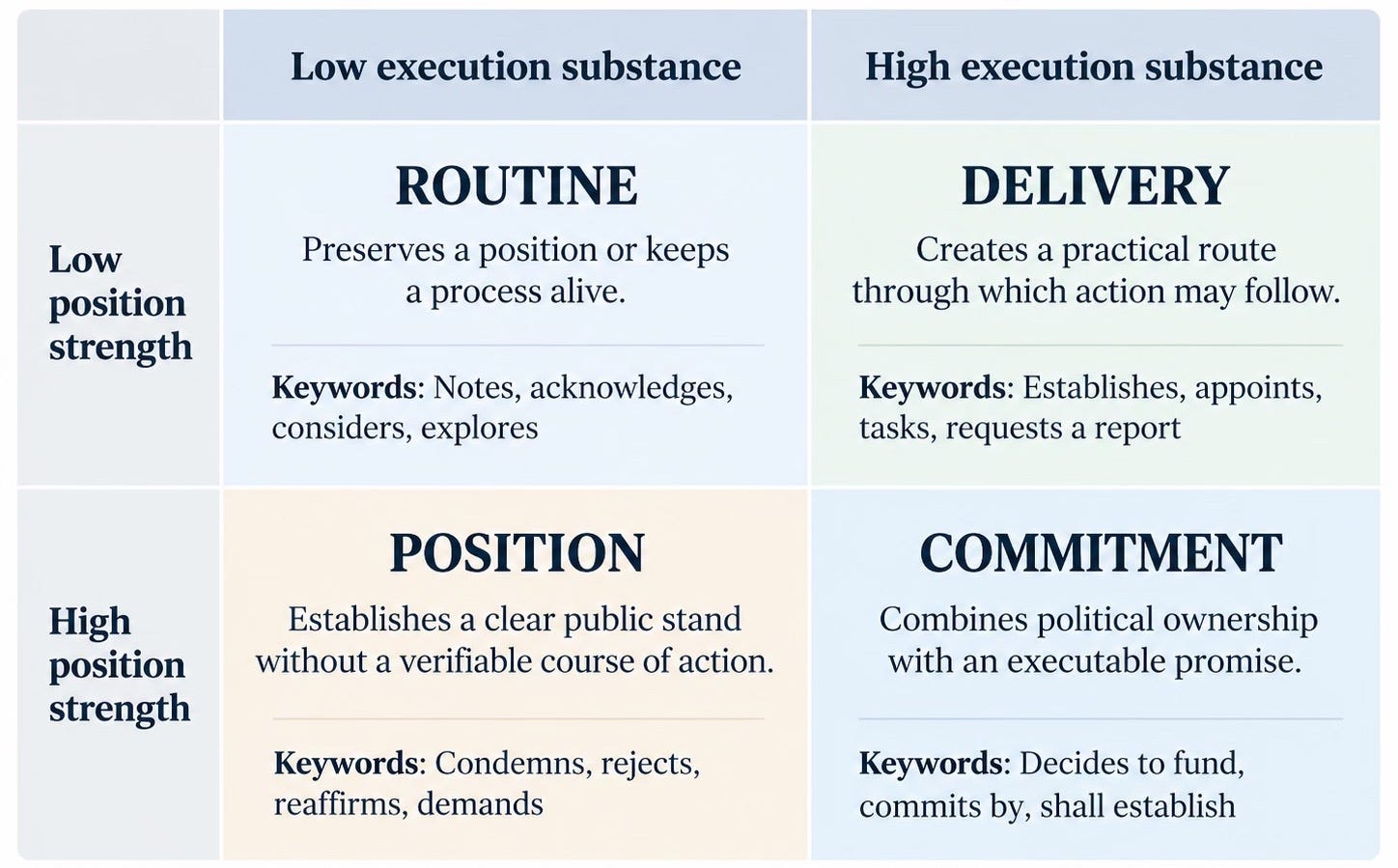
Routine preserves the status quo while sometimes trying to show intent to move in a direction. Position takes a strong stance but fails to establish actionable agendas. Delivery shows the path to action while remaining short of concreteness. Commitment joins political intent with an executable promise leading to action.
These are categories and do not guarantee progression. A sensitive issue may remain under Position for years. A technical initiative may move directly from Routine to Delivery without becoming a public priority.
The unit being classified is an outcome, not the whole declaration and usually not an isolated word. A single paragraph may recognise a problem, welcome an existing initiative or establish a working group. Those are different diplomatic moves.
The kind of document or the authority behind it is also of importance. A collectively agreed leaders’ declaration carries far more authority as a chair’s summary merely records what some participants said. The framework covers political outcomes in declarations, communiqués and joint statements; legally binding instruments require a separate reading.
Routine: Keeping the Issue Alive
Routine language maintains an accepted position, acknowledges work already underway or permits another round of discussion. Its vocabulary includes notes, acknowledges, recognises the importance of, encourages further discussion and looks forward to.
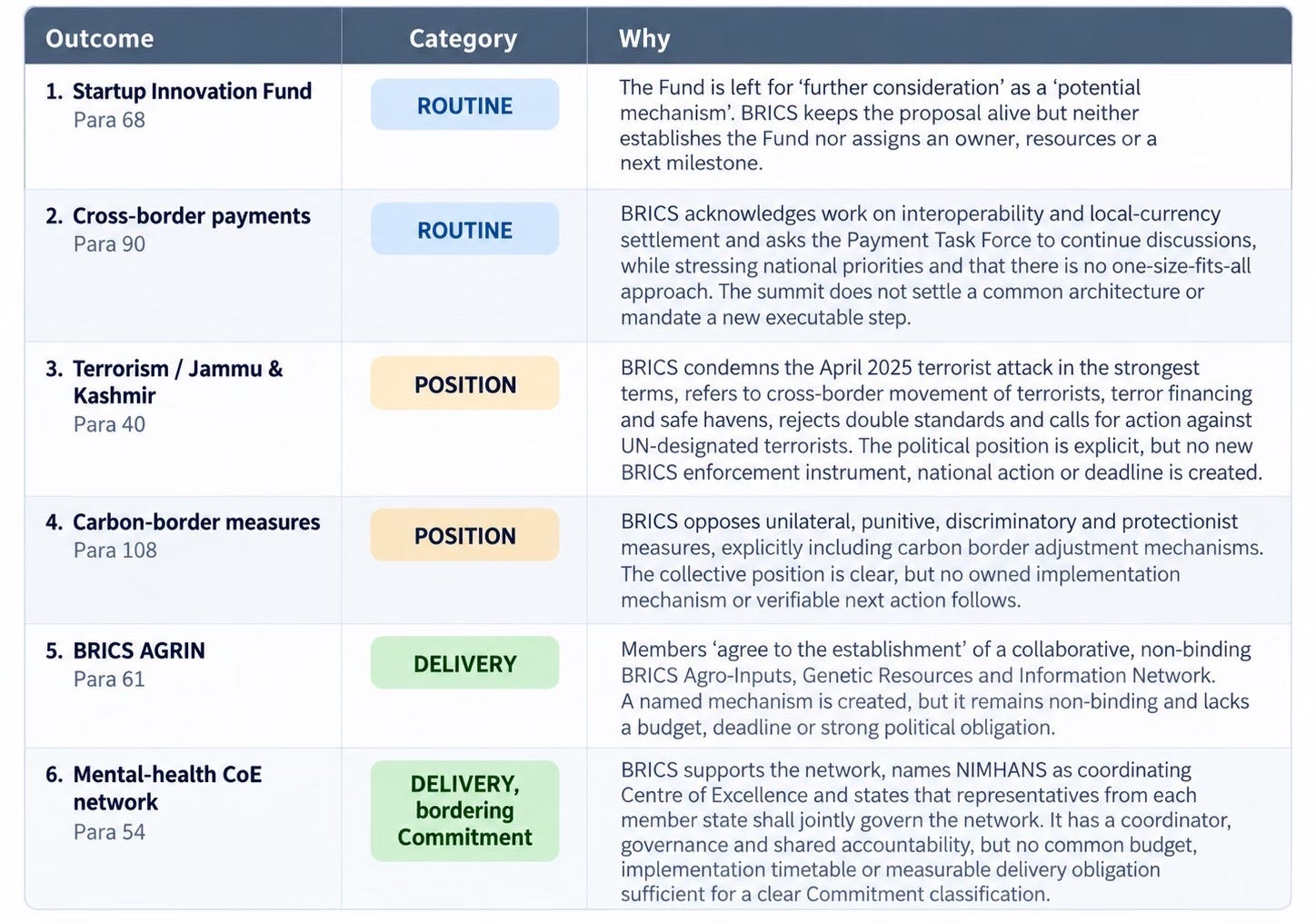
The 2026 BRICS New Delhi Declaration treats cross-border payments in this manner. It acknowledges the work already done, asks the BRICS Payment Task Force to continue discussions and explicitly respects national priorities and the absence of a one-size-fits-all approach. The issue stays alive but a common payment system does not emerge.
The start-up passage in the declaration is equally instructive. A BRICS Startup Innovation Fund is left for “further consideration” as a “potential mechanism”. That is routine. To claim a new Delivery outcome, we would need to check the wider record.
Keeping an idea inside the consensus can prepare a later advance or prevent an earlier agreement from being diluted. Routine maintains but does not necessarily move.
Position: Drawing a Political Line
Position tells the world where countries will stand publicly. Its vocabulary is stronger: condemns, rejects, reaffirms, underscores or demands. Yet a generic condemnation repeated every year may signal less than a specific formulation that members previously resisted.
The 2026 BRICS declaration condemned the April 2025 terrorist attack in Jammu and Kashmir “in the strongest terms”. It referred to cross-border movement of terrorists, terror financing and safe havens, and rejected double standards in counter-terrorism. BRICS members accepted a public stand on an issue of high political importance to India. But they did not assign national actions or create a new enforcement mechanism. The outcome belongs under Position.
The 2023 G7 Hiroshima communiqué strongly opposed attempts to change the status quo by force or coercion and applied that position specifically to the East and South China Seas. It also reaffirmed the importance of peace and stability across the Taiwan Strait. This was a clear, coordinated political line without a new instrument for enforcing it.
A shared position can matter immediately. Governments can cite it later and question conduct that contradicts it. Repetition can turn contested language into an accepted expectation. Position can change the political cost of future choices.
Delivery: Creating the Route to Action
Delivery is often quieter. Its language may say it establishes, appoints, tasks, adopts a roadmap or requests a report. It creates a route to action; it does not claim the final result.
The clearest test is ownership. Did the parties decide, direct or fund a next step, or merely encourage someone else to act? A request can be specific and verifiable without being owned by the signatories.
The 2026 BRICS declaration records a sub-working group, with terms of reference, for an integrated early-warning system on mass infectious diseases. It also supports a mental-health network, names NIMHANS as coordinator and provides for representatives from every member to govern it jointly. These have the structure of Delivery. But where the text welcomes rather than decides to establish, the wider record must confirm whether BRICS created the mechanism or endorsed earlier work.
Other documents provide cleaner examples. The 2023 G20 New Delhi Declaration agreed to create a Working Group on the Empowerment of Women and indicated that its first meeting would take place during Brazil’s presidency. The 2024 Quad Leaders’ Declaration announced a logistics-network pilot, a ship-observer mission planned for 2025 and an inaugural MAITRI training workshop to be hosted by India.
A working group can fail to meet and a network can remain unfunded. Even so, these clauses move from discussing an issue to owning a vehicle for action.
Commitment: Political Intent backed by an Executable Promise
Commitment combines a politically significant position with an owned and executable next step. Its strongest formulations tell us what will be done, by whom, with what resources, by when and under whose review.
This is usually the least populated quadrant in a large summit. Commitment asks sovereign governments with different interests and domestic constraints to accept responsibility for future action. The larger and more diverse the group, the harder the bargain.
Negotiators preserve discretion through phrases such as “as appropriate”, “on a voluntary basis” or “subject to national circumstances”. These do not always empty a promise of meaning. The question is whether they recognise a national process or allow parties to avoid the action.
The 2026 BRICS declaration is thin in this quadrant. Its mental-health network comes closest, but the lack of a shared budget and timetable keeps it closer to delivery. Every declaration need not fill every box.
Large forums can still make clear commitments. During the global financial crisis, the 2009 G20 London Summit agreed on a $1.1 trillion support programme. It specified resources, instructed finance ministers to implement the decisions and required monitoring and reporting.
The 2024 G7 Apulia communiqué similarly decided to make approximately $50 billion available to Ukraine by leveraging revenues from immobilised Russian sovereign assets. It joined a clear political position with a quantified financial instrument.
These are strong agreements on paper. Their material value still depends on what governments and institutions do afterwards.
The matrix can be applied one outcome at a time.
1. Check the Document Type: Who is the Party or Authority
2. Isolate One Outcome
3. Read the full formulation: Does it create, direct or fund, or merely report?
4. Test the position: Would a potential reversal be diplomatically noticeable?
5. Test the substance : Have the parties owned a verifiable next step?
6. Test the qualifiers: National process or an escape from action?
7. Place the outcome: Routine, Position, Delivery or Commitment
Read the full formulation, not the opening verb. “We commit” may lead only to further exploration. “We welcome” may refer to a funded institution that already exists. If an outcome sits between two quadrants, classify it conservatively. Keep it in the lower quadrant unless the stronger reading is supported by the full text and context.
Then return later. Did the designated body meet? Was money allocated? Was the deadline honoured? Did the next declaration strengthen the language, repeat it or quietly drop it?
What the Matrix Can and Cannot Tell Us
Diplomatic language can create political value immediately: reassuring partners, signalling resolve and shaping later negotiations. But every quadrant records an agreement on paper. Domestic politics, limited capacity, leadership changes and deteriorating relations can alter what follows.
International relations must often be read over decades, not summit cycles. Progress accumulates through repeated language, institutions and negotiations before it becomes visible in the world.
The framework therefore supports two readings. On the day of the summit, ask: What position did the declaration establish, and what did it set in motion? In the years that follow, ask: What became of it?
The distinction is simple. The matrix tells us what kind of agreement was secured. National interest tells us whether it was desirable. Implementation tells us whether it eventually mattered.
A Case Study: Applying the Matrix to the 2026 BRICS New Delhi Declaration
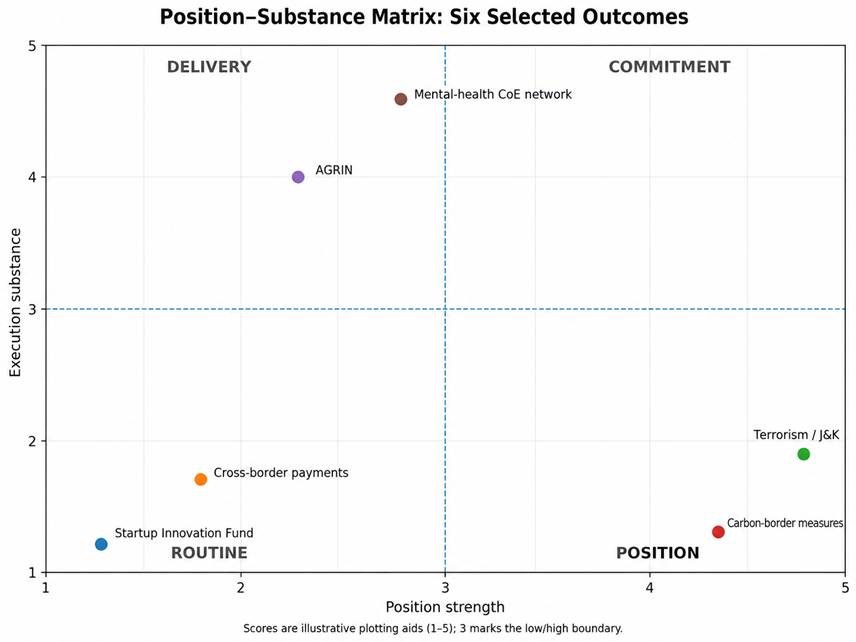
The six outcomes below were selected to show materially different combinations of position strength and execution substance. The 1–5 scores are analytical plotting aids only; the framework itself remains categorical. A score of 3 is used as the visual boundary between low and high on each axis.
What the Matrix Reveals
The most revealing feature of the six-outcome sample is the empty Commitment quadrant. It would be tempting to move the mental-health network into Commitment because its institutional architecture is detailed. But doing so would weaken the framework. The network has a coordinator and a governance structure, yet it has no shared financial commitment, no implementation timetable for the network itself and no measurable obligation to deliver a particular result. The conservative classification is therefore Delivery.
Taken together, the six examples suggest a declaration in which BRICS was capable of taking strong political positions and of creating practical delivery mechanisms, but the two rarely converged into hard, executable political commitments.
This is what frameworks like our matrix reveal and aids. Wordplay may tempt one into believing an action or development may soon follow; a guided analysis actually tells what is likely to follow as an aftermath of a diplomatic gathering.
Source Note
BRICS New Delhi Declaration: Building for Resilience, Innovation, Cooperation and Sustainability, 12 September 2026, Ministry of External Affairs, Government of India.
Authored By: Kumar Subham, CEO and Co-Founder, India House