
For the last ten years, Rakesh has been saving to buy a home in Delhi.
Rakesh works as a carpenter, lives with his family in a rented house and puts aside whatever he can with only one dream, a house of his own. But every few years, his dream moves further away from reality. His savings have grown, but the price of the house he wants to buy has grown faster.
Rakesh’s problem is not unusual. For millions of Delhi residents, buying a home increasingly feels like chasing a moving target.
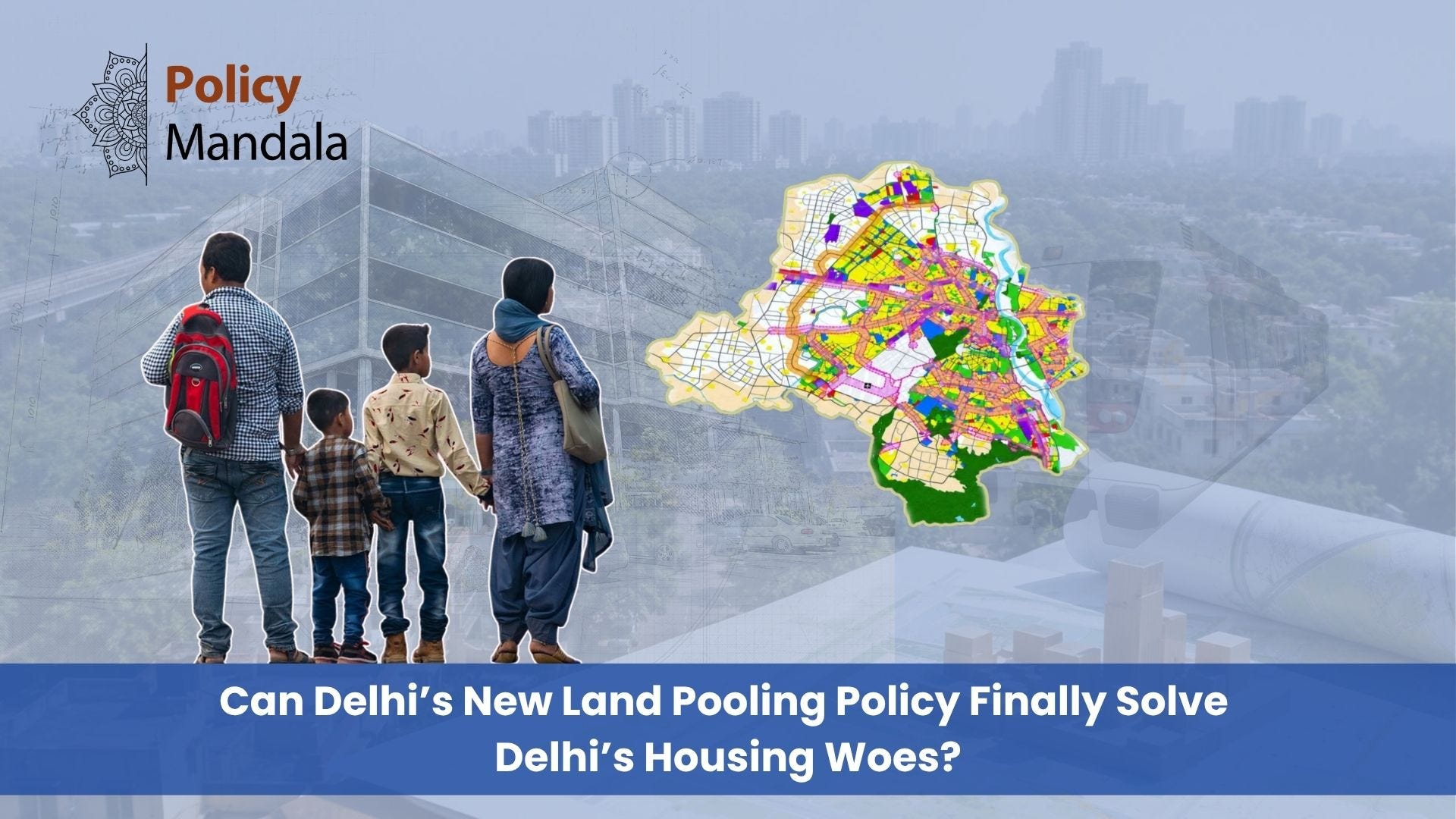
Besides market dynamics, underneath Delhi’s housing problem lies a more basic challenge. Delhi can add people, jobs and businesses. However, what it cannot add is land.
Spread across roughly 1,483 sq km, much of Delhi is already built up or committed to settlements, roads, public institutions and environmental uses. Yet around 19,074 hectares has been identified as poolable land.
Recently, Delhi notified the Master Plan for Delhi 2047 (MPD-2047), which sees unlocking this land as an important part of accommodating future growth. And its big bet is an old idea Delhi has struggled with for more than a decade: land pooling.
So, what exactly is land pooling? Can Delhi make it work? And will it really help solve Delhi’s housing woes?
These are the questions we explore in today’s Policy Mandala.
Before we begin, let us understand land pooling with a simple example.
Imagine 100 farmers or landowners owning adjoining pieces of land on Delhi’s periphery. Under traditional land acquisition, the government acquires their land, pays compensation and then plans the area.
Land pooling attempts something different.
Instead of exiting the process, landowners become participants in the future city. Their plots are brought together into a larger planning area. Some land is set aside for roads, parks, schools, utilities and public infrastructure. The remaining land is reorganised and returned as smaller, but developable, urban plots.
The bet is simple: you may get less land back, but the land you get back should be worth much more.
For the government, this reduces dependence on expensive acquisition. Landowners participate in the increase in land value, while private developers gain access to planned, developable land.
The idea looks good. But has it worked in Delhi before?
Land pooling entered Delhi’s planning framework in 2013 and was significantly revised in 2018. Yet willingness has been registered for only around 6,930 hectares, or 36% of the identified poolable land, without development at a comparable scale.
The problem was not necessarily the idea. It was the mechanism.
Under the earlier framework, development could proceed only after at least 70% of contiguous developable land in a sector had been pooled. Landowners also had to organise themselves into consortiums.
Suppose 72 out of 100 owners agree. Technically, the threshold has been crossed. But their plots may not sit next to each other. One plot may have several owners, only some of whom agree. Another may be disputed or encroached upon.
The result is a classic policy problem: the incentive makes sense for each landowner individually, while the system still fails collectively.
So, what does MPD-2047 do differently?
The new framework changes who solves the coordination problem.
Landowners with sufficiently large contiguous holdings can approach DDA directly, reducing dependence on large self-organised consortiums. More significantly, MPD-2047 introduces Town Planning Schemes (TPS) as an alternative route.
Under TPS, DDA can identify an area, prepare the planning framework, reserve land for roads and public infrastructure and reconstitute the remaining plots. Once an area is notified, participation can also be made mandatory, reducing the ability of a few holdout landowners to stall development.
In simple terms, Delhi is moving from landowners coordinate first and planning follows towards planning framework first and land is reorganised within it.
This may reduce holdouts, but it can create property-rights disputes, litigation and landowner distrust if plot reconstitution, infrastructure commitments or the distribution of gains is perceived as unfair.
Which raises the larger question: Has land pooling actually worked elsewhere in India?
Ahmedabad offers perhaps the strongest long-term example.
Gujarat had experimented with Town Planning Schemes for decades, but implementation remained slow because authorities often had to wait before taking possession of land required for roads and infrastructure.
In 1999, Gujarat changed the mechanism, allowing authorities to take possession of land needed for roads and public purposes once the draft scheme was approved. This allowed infrastructure and land readjustment to move together. Over time, Town Planning Schemes became an important instrument through which Ahmedabad expanded its road network and brought peripheral land into planned urban development.
Amaravati tested the idea at a very different scale.
Around 29,000 farmers pooled more than 34,000 acres for Andhra Pradesh’s proposed capital in return for smaller serviced residential and commercial plots, annuities and other benefits.
It showed that landowners can part with land at enormous scale when they believe the developed plots returned to them will eventually be worth substantially more. But the project slowdown between 2019 and 2024 delayed infrastructure and weakened that confidence.
Together, Ahmedabad and Amaravati explain why land pooling succeeds or fails.
The government must be able to overcome coordination and holdout problems. Landowners must trust that the land returned to them will actually gain value. And that value materialises only when roads, water, sewerage and other infrastructure arrive.
Delhi appears to have redesigned the first part of this equation. The harder test is whether it can deliver the second.
Because even successful pooling solves only the land-assembly problem.
Land records remain complicated. Multiple ownership, inheritance disputes, encroachments and contested titles do not disappear because a Town Planning Scheme has been notified.
Infrastructure must then follow. A reconstituted plot becomes valuable only when connected to roads, drainage, water, sewerage, power and transport.
Private-sector economics matter too. Developers will build only when expected returns justify land costs, infrastructure charges, finance and regulatory risk.
And then comes perhaps the least visible problem: who delivers the neighbourhood once DDA reorganises the land?
A new sector may require DDA to plan it, revenue authorities to resolve ownership, Delhi Government agencies and utilities to provide infrastructure, MCD to deliver municipal services and private developers to build.
Land pooling may therefore solve the problem of fragmented land while leaving Delhi with the problem of fragmented government.
And even if all this works, one distinction matters.
Unlocking land is not the same as making housing affordable.
Delhi may successfully convert thousands of hectares into developable urban land and still see developers build homes that Rakesh cannot afford. Housing prices will ultimately depend on land values, infrastructure costs, financing, density, location, demand and what the market finds profitable to build.
MPD-2047 may therefore have found a better way to assemble Delhi’s land. But assembling land is only the first step towards creating a neighbourhood, and creating a neighbourhood is still only the first step towards making a home affordable.
So, will land pooling make a difference to Rakesh?
We do not need to wait until 2047 to find out.
Watch five things: land converted into serviced development, time taken to reconstitute titles, infrastructure delivered alongside development, homes completed and occupied, and connectivity of new neighbourhoods to jobs and mass transit.
For planners, success may eventually be measured in hectares pooled and floor area created.
For Rakesh, the test is much simpler.
After years of saving for a home in Delhi, does the city finally begin to make room for him?
Co-Authored by : Samridh Joshi & Avdhesh Pathak
Read Our Previous Editions:

Opportunity Alert!
India needs its best minds to solve its toughest challenges.
And that requires people with the intent and ability to act.
People who can understand systems, shape policy, work with stakeholders, and navigate implementation.
These are capabilities built through 3 things: Experience, Exposure and Practice.
Yet opportunities to build these capabilities through practice, not just theory, remain limited.
To help bridge this capability gap, India House’s flagship initiative Policy Pioneers Program, brings together: Practitioner insights, Real-world projects, Field exposure & Structured skill-building.
for professionals looking to engage more effectively with public systems.