
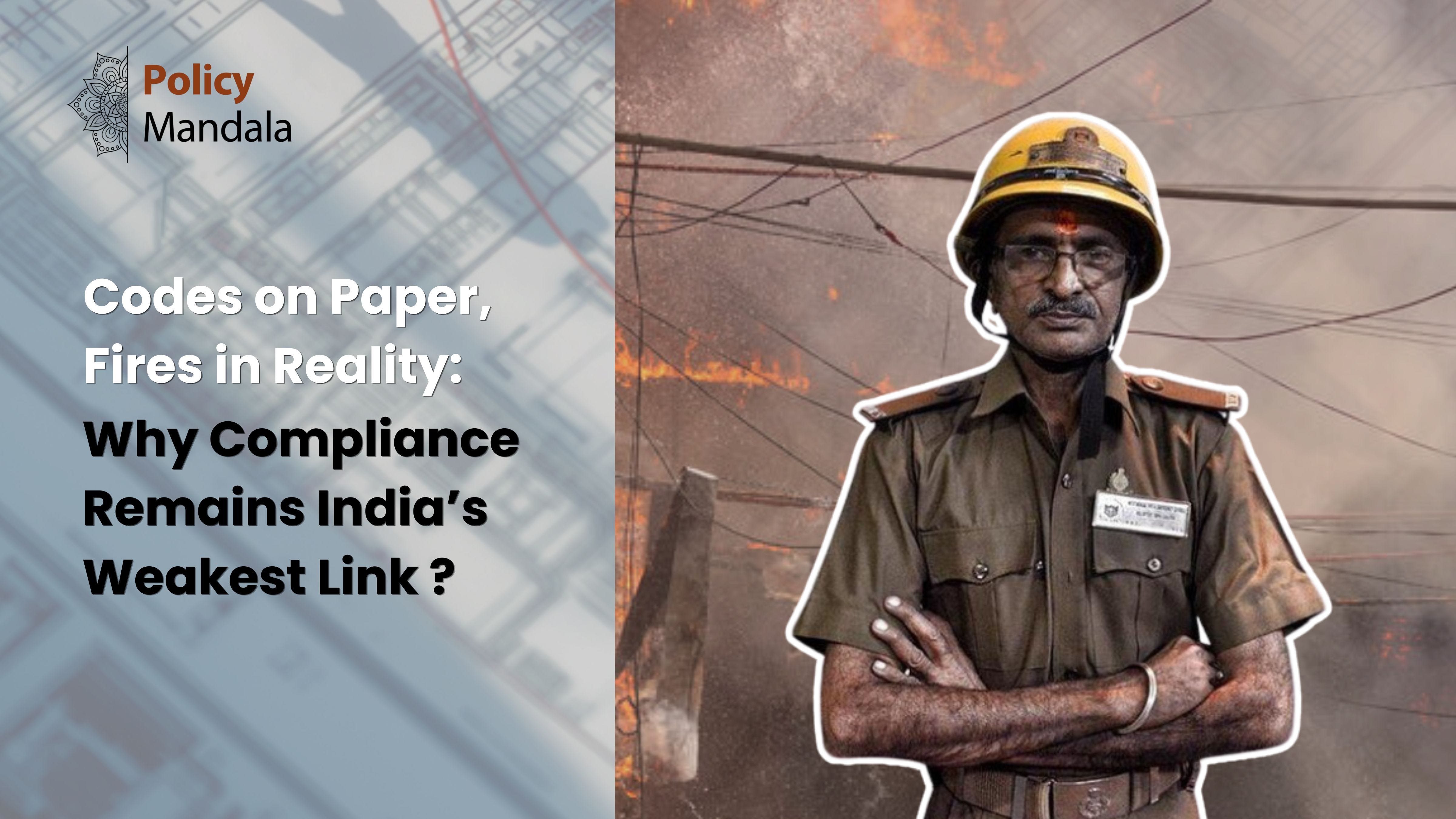
June 3, 8:30 AM, Malviya Nagar, New Delhi. A raging fire spread through five floors of Flourish Stay Inn, trapping the guests who were soon burnt alive in a horrific episode. 23 people were dead, and several more were injured in a span of merely a few hours. Many of the deceased were foreign nationals and tourists.
Nearly 1 person loses their life every hour to fire accidents in India, with residential buildings accounting for a staggering 54% of all deaths. This is despite the existence of the National Building Code, National Disaster Management Authority (NDMA) guidelines and dedicated fire safety squads.
This week’s Policy Mandala deals with the question of why buildings continue to burn in India despite regulations and how to remedy the alarming situation. The first question we will ask is whether there is an inadequacy of fire-safety regulations and their integration into building construction practices. The second is about preparedness for fire incidents. And the third is what can be done.
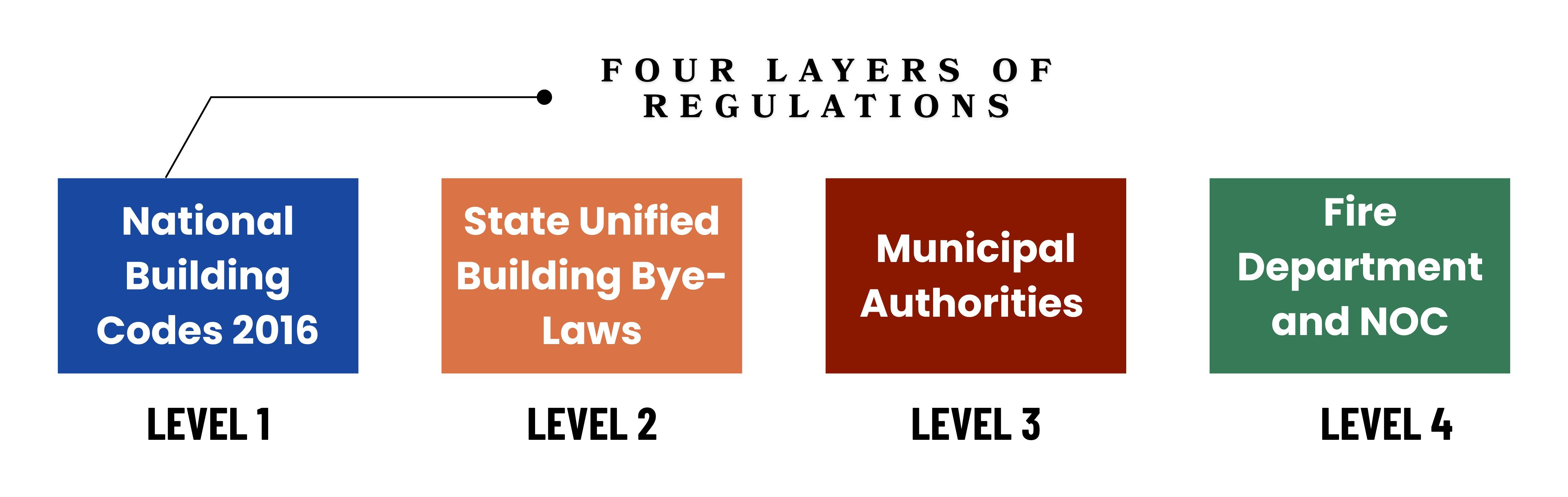
India’s fire safety regulatory structure is built around four layers. The first layer is the National Building Code (NBC) 2016, the second is the Unified Building Bye Laws of the State, the third is the Municipal Administration, and finally the Fire Department. The NBC dictates principles, the Bye Laws dictate precise provisions, the Municipal Administration enforces compliance, while the Fire Department reviews the plans for No Objection.
Every layer is a distillation of the National Building Code, which will be our focus of discussion.
The National Building Code of India, developed by the Bureau of Indian Standards, is a comprehensive set of rules to manage the design, construction, upkeep, and operation of buildings all over India. Part 4 of the Code deals specifically with fire and life safety and prescribes requirements relating to fire prevention, means of escape and evacuation, fire-resistant construction materials, smoke detection systems and more.
The NBC thus devotes an entire section of more than 150 pages to fire and life safety requirements, making it one of the most comprehensive building safety codes in the developing world.
On paper, India does not suffer from a complete absence of fire safety rules. The problem is that a detailed technical framework sits on a weak legal, enforcement, and capacity base.
First, while the NBC details fire safety regulations in building construction and approval, the codes are not legally binding, leaving legal enforcement in the lurch.
And secondly, the codes do not apply to residential buildings less than 15 meters in height, leaving a significant fraction of India’s homes out of the regulatory ambit of the codes.
But would a legally binding, uniform application of the Building Codes solve the problem? As it turns out, the answer is no.
Firstly, enforcement remains poor and dependent on the intent and will of the municipal authorities, most of whom fail at the task. Building plans and maps are passed by the officials in a shroud of non-transparency, often masked under heavy bribes. Popular sources suggest that the amount may go as high as ₹ 2 lakhs per building. Amidst this, regular inspections are a rarity.
Household surveys are a major missing link in the problem of enforcement. After a plan has been passed, there is no subsequent enforcement of construction and maintenance, leaving no incentive for compliance.
However, even if the ambit of prevention and building safety is satisfied, India’s fire services are simply not equipped to deal with the challenges. A good case study is the Delhi Fire Services.
Delhi Fire Services (DFS) is supposed to operate approximately 71 stations, including headquarters and training facilities, out of which only 4 are operational during daytime. These four stations are hence supposed to deal with approximately 100 emergency calls per day and cover an area of nearly 1500 square kilometres.
And why this state? Nearly one-third of DFS’s positions are vacant. And one fourth of the critical operational positions have no staff.
A testimonial from a senior official at the Geetanjali Fire Station, one adjacent to the Malviya Nagar fire site, reads that while the station got a new fire tanker, the staff capacity remains the same.
Recent reports and older CAG audits have repeatedly flagged outdated communication equipment (such as radios), insufficient modern vehicles, maintenance issues, and slow infrastructure expansion.
India’s fire safety problem is not a problem of absent rules. It is a problem of dead rules: codes that are not legally binding, inspections that are not routine, buildings that change use after approval, fire departments that remain understaffed, and citizens who discover non-compliance only after tragedy strikes.
But how do we remedy this situation? How do we make India’s infrastructure and systems fire resilient?
We believe that traditional suggestions won’t cut it. Compliance needs not only to be legally enforced but also driven through social pressures and market incentives.
Firstly, a star-based rating of commercial buildings needs to be introduced. This rating needs to be based on objective criteria, evaluated by third-party agencies for instance, the Bureau of Energy Efficiency (BEE), which deals with electricity ratings.
Tokyo’s Yu Marksystem building system, which recognises excellence in fire safety, is a good model where establishments can display the mark at entrances and in advertisements, making fire safety visible to users and customers.
Parameters of such ratings can include visibility of fire safety rules, compliance with building codes, equipment readiness and self-efforts at fire safety. Marketing of such ratings widely, especially amongst tourists, both domestic and abroad, can create strong market pressures for fire safety.
Secondly, enforcement should move beyond prosecution to incentivization. Penalisation and incentivization should follow tax structures. A non-compliant building can be slapped with higher rates, while a highly rated and voluntarily compliant entity may get attractive GST rebates.
Thirdly, aggregators such as OYO, MMT, Booking.com, Agoda, amongst others should be mandated to enforce ratings and information based on fire safety norms and compliance with their clients and vendors.
Just as food delivery platforms display hygiene and restaurant information, travel aggregators must display fire safety status. A guest should not discover a blocked exit after the fire has already started. This creates a market penalty for unsafe buildings.
Fourthly, India should move from “NOC at approval stage” to a live compliance model, where hotels, hospitals, schools, malls, coaching centres, and high-occupancy buildings must maintain an active, publicly verifiable fire safety status. Singapore’s model may guide where a three-year Fire Certificate renewal cycle with annual submission requirements in between is the norm.
Finally, there is no training or grading system for private architects to promote fire safety compliance in mapping and planning of residential and commercial spaces. Modular training courses and certifications for architects can help create a skilled force for fire-resistant designs in construction.
Fire safety in India is a combination of enforcement, compliance and capacity. While there appears to be robustness on paper, the implementation simply does not stand up to scrutiny. Incentives may help as suggested, but what merits even more attention is effective civic awareness and training.
For incentives to work, fire safety has to move from policy rooms to households. And civic volunteer training is to complement the same, geared towards developing instincts in case of a fire accident.
Ultimately, there is no “opportune time” to implement disaster preparedness measures, because disasters rarely arrive with warning. The Malviya Nagar incident is a painful reminder that fire safety is not a procedural formality, but a life-saving obligation.
Had emergency exits and other basic safety requirements been ensured in compliance with the National Building Code, 23 lives may have been saved. Their loss must not be treated as an unfortunate accident alone, but as a consequence of systemic defects in India’s fire safety structure.
No citizen deserves a painful death because systems failed to do what they were already mandated to do. The time for remediation is not after the next tragedy. It is now.
Co-authored by Samridh Joshi and Avdhesh Pathak