
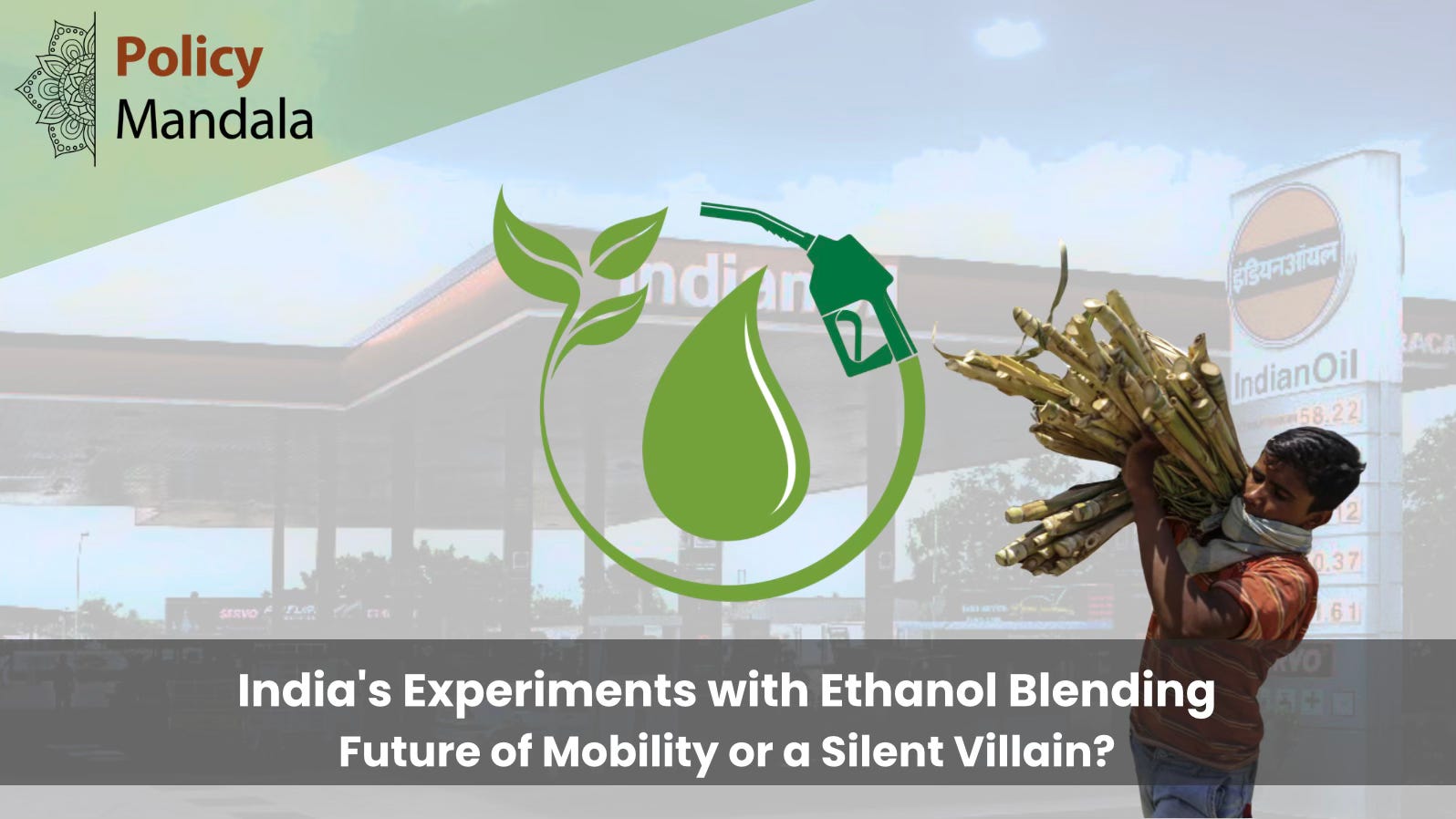
Imagine, next time you visit your nearby fuel station, you notice a new fuel option flashing on the price board. It’s cheaper than your usual petrol, and the maths seems simple: lower price, bigger savings. Or is it? Is this a steal deal, or is there something hidden beneath the savings?
Earlier this month, India introduced the E85 blend in petrol for the first time. The blend was available at a discount of ₹20 on the present petrol price per litre. However, this announcement sparked deep debates and divided opinions on social media.
With over 40 billion litres of petrol sold annually and over 50 million cars on India’s roads, ethanol blending is no small experiment. It impacts fuel prices, vehicle performance, farmer incomes, oil imports, and even the crops India chooses to grow.
And this is why today’s Policy Mandala chooses to untangle the debates behind ethanol blends, and shows how an idea with the right intent can create real costs when policy design ignores the consumer.
When ethanol is mixed with petrol, the blend is named by the share of ethanol in it. For instance, petrol with 20% ethanol is called E20, while petrol with 85% ethanol is called E85.
This blend is cheaper to manufacture, and unlike petrol, which comes from crude oil, ethanol is produced from crops such as sugarcane and foodgrains, making it a renewable alternative.
India’s ethanol experiment is not new.
Ethanol blending in India began in 2003. For years, it remained a modest experiment before scaling into a national fuel policy. By July 2025, India achieved its E20 target of complete and uniform coverage throughout India, five years ahead of schedule.
Today, nearly all fuel stations dispense E20 petrol.
However, the target of E20 was not enough, as the government, inspired by flex-fuel vehicles and high-ethanol blends, announced higher blending targets and eventually launched the E85 blend on a pilot basis.
There are four major drives behind the government’s push for higher ethanol blends.
At one level, it is energy security. With nearly 85% crude oil dependence and an import burden of over ₹11.5 lakh crore, ethanol blending helps cut fuel imports and save valuable foreign exchange reserves. By 2026, the E20 programme has reportedly saved India around ₹1.84 lakh crore.
At another, it supplements India’s agricultural economy. Sugarcane procurement for ethanol production has transferred nearly ₹1.25 lakh crore to farmers, especially benefiting sugarcane-producing regions like western Uttar Pradesh and Maharashtra, where cane pricing and procurement are politically and economically significant.
Also, ethanol blending has helped avoid over 736 lakh metric tonnes of CO₂ emissions, supporting India’s Net Zero goals. This is because ethanol emits less CO₂ per litre than conventional petrol.
And finally, ethanol blending creates productive use for surplus grains, damaged stocks, and agricultural waste through first and second-generation ethanol production.
Thus, the intent is not in question. Then why do we call the ethanol blending program a poorly conceived policy design, and what led us here?
The first reason is that it does not transfer benefits to the consumers. The key principle of user-centricity in policy has been ignored.
Petrol prices remained broadly the same as earlier unblended petrol, even though ethanol blending was expected to reduce fuel costs.
What made this worse was the loss of choice.
E20 became the default fuel across stations, while unblended petrol quietly disappeared from the consumer’s options. Even premium performance fuels, including Indian Oil’s XP100 and HP’s Power99, now come with ethanol blending. So the consumer is left with no real alternative.
The second reason is a neglect of the individual economics of transport. This aggravates the first problem.
Ethanol has a lower energy value than petrol, which means vehicles need more fuel to travel the same distance.
Pure ethanol produces roughly 30% less energy per litre than petrol. In practical terms, E20 can reduce mileage by around 1 km per litre, while E85 could reduce it by around 4 km per litre compared to unblended petrol.
So even if the pump price looks just right, the real cost may be higher. At current prices, this could mean an effective loss of nearly ₹7 per litre for E20 and around ₹28 per litre for E85. In short, the consumer may be paying less at the pump but more on the road.
Thirdly, the policy design gap becomes even more visible when we look at whether India’s vehicle fleet is ready for blended fuel.
Ethanol absorbs water more easily than petrol, increasing risks of rust in tanks, pipes, and injectors. In older vehicles, it can also damage rubber and plastic parts such as fuel lines and gaskets. At high blends like E85, non-compatible vehicles may even face stalling.
At very high blends like E85, the risk becomes sharper. Vehicles that are not designed for such blends may face serious performance issues, including engine stalling.
India reportedly has only one E20-compliant vehicle for every hundred vehicles on the road. That leaves a large share of vehicles potentially exposed to compatibility risks.
This is a classic example of putting the cart before the horse.
Finally, the government is trying to solve one resource problem by deepening the other. Ethanol is expensive, but not in the usual way.
Producing one litre of ethanol can require nearly 1,500 to 3,000 litres of water. In a country where 600 million people face water scarcity, and demand is expected to double by 2030, this is a serious hidden cost.
The pressure also reaches the soil. Ethanol procurement risks rewarding water and nutrient-intensive crops like sugarcane, at a time when India should be moving towards crop diversification, pulses, legumes, and natural soil restoration.
Identifying the policy failures, the natural question that comes to mind is, ‘Should India roll back ethanol and go back to square one?’
Not really. Ethanol has clear benefits for energy security, farmers, and emissions. The problem is not the intent; it is the design.
The better path is to make ethanol a choice, not a compulsion. Unblended petrol should remain available, especially for older vehicles and premium fuels. E20 and E85 should be priced competitively enough for consumers to choose them willingly, not absorb hidden mileage losses silently.
India should also move ethanol away from sugarcane dependence. Second-generation ethanol from agricultural waste, and eventually third and fourth-generation fuels, can be explored.
Finally, flex-fuel vehicles need a serious push through lower GST, road tax concessions, registration benefits, and purchase incentives. If we want higher ethanol blends, engines must be ready before fuels are forced.
The EV transition worked because it built consumer trust, incentives, and choice. India’s ethanol story should learn from that. Ethanol is not the villain. Poor policy design is.
Co-authored by Samridh Joshi and Avdhesh Pathak