
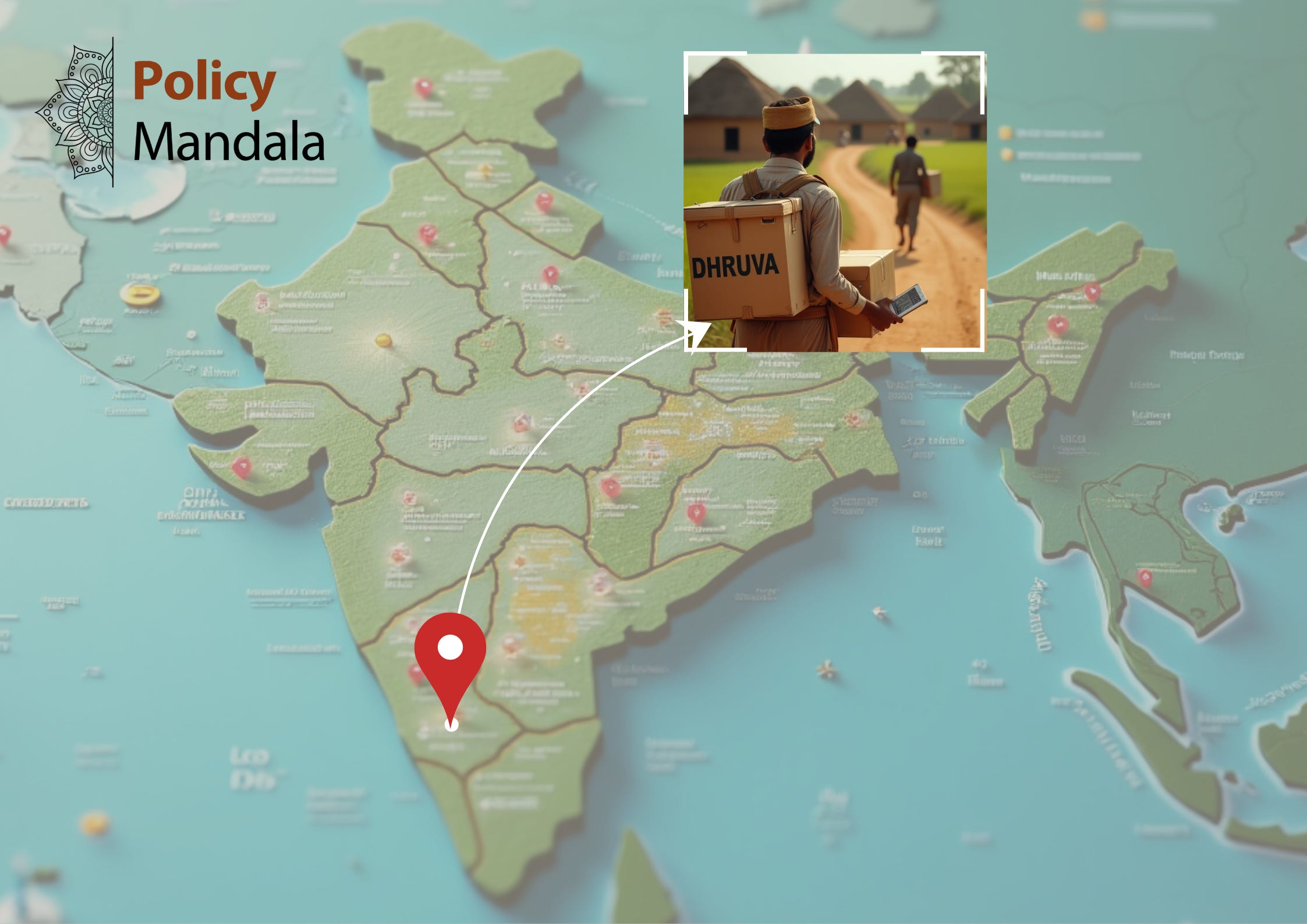
Sometimes, the biggest transformations don’t arrive with fireworks. They quietly slip into the fabric of everyday life, until one day, everything feels dramatically simpler.
India may just be standing at the edge of one such transformation. It’s not about space rockets, not about AI, not about electric cars. This time, it’s about something far more basic. An address. The one thing each of us uses countless times — to guide a friend to our house, to visit a new place, to receive deliveries, or for government documents — but never truly notices how broken it has been.
In this week’s Policy Mandala, we are here to decode this journey. Because if DHRUVA succeeds, it can rewrite how 1.4 billion Indians identify where they live, how businesses find them, how governments serve them, and how India’s digital public infrastructure quietly takes one more giant leap.
Today, if you want groceries delivered to your apartment in Ghaziabad, you probably type something like: “Flat 4B, near Sharma Medical Store, Mohan Nagar, Ghaziabad - 201017.” It sounds fine — until the delivery agent calls you frantically. “Bhaiya, landmark kya hai?” And that tiny, daily headache gets repeated across millions of homes, every single day.
India’s address system is wildly inefficient.
Our 19,000 PIN codes cover huge swathes of land — each PIN roughly maps 170 square kilometers. That’s nearly 10,000 cricket stadiums bundled into one postal code! No wonder a lot of deliveries fail, welfare schemes misfire, property records get disputed, and service providers struggle in reaching ‘you’. In fact, according to one 2018 estimate, India’s broken address system costs us nearly ₹83,000 crore to ₹1.16 lakh crore annually — around 0.5% of our GDP. Because when addresses are vague, deliveries fail, welfare benefits miss the right person, paperwork piles up, and people spend hours explaining “landmarks” over phone calls — across millions of people, that waste adds up fast.
Enter DHRUVA.
Launched in the first week of June by the Department of Posts in collaboration with ISRO and IIT Hyderabad, DHRUVA — Digital Hub for Reference & Unique Virtual Address — aims to finally fix India’s address problem at the root. And it does so with a fascinating twist at two levels: first, instead of our vague, text-based addresses, every location in India will soon have a unique 10 digit DIGIPIN — a precise 4x4 meter square, mapped through satellite-based geocoding.
Yes, 4x4 meters. That means your doorstep, not just your building or street. Across India’s 3.287 million square kilometers, that means about 205.4 billion possible DIGIPINs.
Much of this draws upon India’s growing geospatial backbone, built steadily through platforms like ISRO’s Bhuvan, which has been mapping India's physical infrastructure for years. DHRUVA builds on top of this to finally give every individual a precise, verifiable digital address.
The second is the Digital Address Layer — where users can create human-readable, customizable handles like rahul.kumar@dhruva, mapped to their unique DIGIPIN. Together, these two layers turn every location into a verified, shareable, and legally usable digital address.
Of course, the idea of digital addressing isn’t entirely new. India’s experiments with this began as early as 2016, when MapmyIndia launched eLoc, assigning unique 6-character codes to locations across India. Around 2020, startups like Pataa entered, allowing users to create personalized address short-codes paired with voice directions. More recently, platforms like BHASKAR, supported under Startup India, have also emerged to build digital addressing solutions for India’s evolving logistics and governance needs.
Globally too, countries like the United States (National Address Database), Australia (Geocoded National Address File), Ghana (GhanaPost GPS), and the United Kingdom (National Address Gazetteer using Unique Property Reference Numbers) have built national address registries to bring precision and standardization.
But isn’t this what Google Maps already does? Not quite.
Google Maps helps you navigate. DHRUVA ties your location to your identity. It helps you prove and securely share your address. Your Google location pin can’t be used as legal address proof, doesn’t give you control over who sees it, and can’t be officially verified for government or financial services. DHRUVA, on the other hand, allows you to create a personal handle — say, rahul.kumar@dhruva — that ties your physical location to a verified digital identity.
And unlike Google, where your data lives on corporate servers, DHRUVA’s architecture is fully privacy-by-design, consent-based, federated, and entirely governed by Indian law under the Digital Personal Data Protection Act, 2023.
But what does this mean for you and me?
Imagine applying for a government scheme that requires proof of address. Instead of submitting electricity bills, rental agreements, or Aadhaar printouts, you simply submit your verified DHRUVA handle. The official will be able to instantly validate your address through authorized verification agencies (AAVAs), no back-and-forth paperwork.
Ordering a parcel? Your DIGIPIN leads the delivery person directly to your doorstep — not somewhere near a random “Sharma Medical Store.” No more frustrating calls. No more failed deliveries.
And perhaps more importantly: life isn’t static — homes change, plots get divided, people move, tenants shift, land parcels mutate. Traditional GIS or address systems can’t keep up with these changes. But DHRUVA is designed for this dynamism.
If a property gets subdivided, DIGIPINs can be reassigned accordingly. When ownership changes, your Digital Address handle can simply be revoked or transferred to the next occupant while the location remains fixed. Even tenants or migrants can dynamically update their address handle as they move.
In short, DHRUVA introduces something India’s addressing system has long lacked: updatable, portable, citizen-controlled addresses.
For businesses — especially in logistics, e-commerce, fintech, proptech, and emergency services — DHRUVA could be a game-changer. Today, logistics eats up nearly 14% of India’s GDP, which is too high compared to 8-9% in developed economies like the US or Germany. Inefficient last-mile delivery and poor addressing are huge reasons why. Even capturing one-fourth of this inefficiency through DHRUVA could save us around ₹20,000 to ₹30,000 crore annually — that’s equivalent to around 0.1% of GDP.
Yes, DHRUVA is in the future — a window into what could soon become possible.
In not-so-distant future drone deliveries, too, could finally become practical at scale. With DHRUVA’s pinpoint accuracy, autonomous drones won’t have to “guess” where to drop a parcel — the 4x4 meter grids allow them to land precisely where they should, even in dense urban settings or remote villages.
The policy’s potential is equally massive for governance. From land record digitization, to identifying benami properties, preventing shell companies fraud, simplifying land acquisition, and even revolutionizing the Census process — DHRUVA’s granular data can plug into dozens of systems that today function in silos.
Of course, it isn’t perfect yet. For instance, DHRUVA currently doesn’t fully capture vertical separation — meaning two apartments stacked on top of each other may initially share the same DIGIPIN. But even here, the architecture allows descriptive add-ons (like “Flat 4B, 3rd floor”) and future upgrades as technology matures.
Beyond that, there are policy gaps — from lack of financial incentives for private players, to legal complexities around ID linkages, limited coordination with land records and AgriStack, and the need for robust data governance as adoption scales.
But amid these challenges, the government is also laying the groundwork to attract innovation and private sector participation.
The government has offered open APIs (Application Programming Interface) and plug-and-play integration, allowing startups and companies to build services atop DHRUVA — just like they did with UPI and Aadhaar. Think about logistics firms integrating DHRUVA to optimize their routes, or fintech startups offering faster, cheaper address verification for KYC.
And internationally, this isn’t just a domestic exercise. India’s DPI model which forms a major portion of the India Stack — Aadhaar, UPI, DigiLocker, e-KYC — is being actively exported globally, with over 20 countries adopting parts of it through platforms like MOSIP and NPCI International. As Industrial 5.0 approaches — an era of AI-driven, human-centric governance — India’s DPI leadership may well become a soft-power asset that shapes the global digital architecture.
What’s happening quietly with DHRUVA, therefore, is far bigger than an address reform. It’s India building the fourth layer of its digital public stack — after digital identity, payments, and data empowerment. It’s yet another audacious attempt to turn an everyday pain point into a globally exportable public good.
The real test now lies in how well we implement, how transparently we govern, and how much trust we can build among citizens to opt in. More importantly, we still await a clear timeline from the government — will this take decades like the Chenab Bridge, or move with the speed of UPI?
But if we pull it off, your simple act of sharing your address may soon become one of the most elegant proofs of India’s grand digital journey.
And that — is why we are talking about DHRUVA this week.
Book Mandala
In this section, we suggest a book to be read/listened to each week, for the inner policy enthusiast in you :)
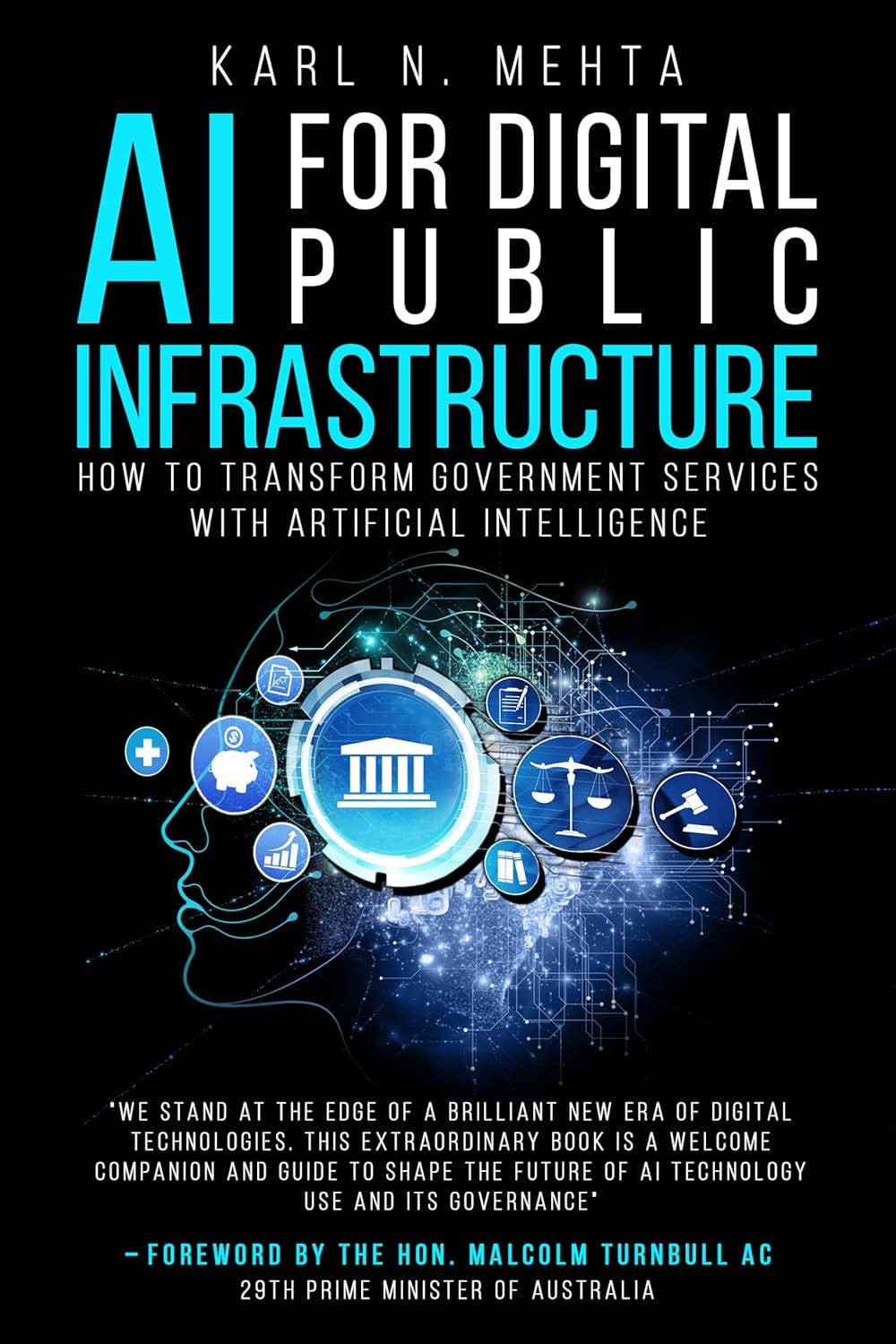
Book: AI for Digital Public Infrastructure
Author: Karl N. Mehta
About the Book:
In AI for Digital Public Infrastructure, Karl N. Mehta offers a highly accessible, deeply practical blueprint for how governments can embed artificial intelligence into their public service delivery frameworks. Drawing from case studies across sectors, Mehta breaks down the building blocks of Digital Public Infrastructure (DPI) — including identity, payments, data sharing, and geospatial platforms — and shows how AI can make them smarter, more responsive, and more inclusive. The book covers everything from consent architecture and service personalization to real-time policy feedback loops, offering a grounded playbook for public sector leaders navigating the next wave of digital governance.
Our Take:
What makes Mehta’s work especially timely for India’s DPI journey is its clear articulation of how AI can serve as a “second layer” atop the robust DPI stack India is already building — Aadhaar for identity, UPI for payments, DigiLocker for data, and now DHRUVA for addresses. Mehta emphasizes that true AI-powered governance isn’t about replacing human decision-making but about making public services more adaptive, predictive, and citizen-centric — exactly the vision that platforms like DHRUVA could soon enable. For policymakers, technocrats, and young professionals working at the intersection of governance and technology, this book offers a crisp, globally relevant lens on where India — and the world — may be headed next.
Co-authored by Mrinal Rai and Aswathi Prakash.
Hope you liked today’s Policy Mandala!
We believe nation-building needs a community of changemakers—so we’re creating Bharat Mandala, an ecosystem for impact. Be part of our journey here!
Thanks for reading Policy Mandala! Subscribe for free to receive new posts and support our work.