
Kahaan Patel was merely 17 years old on the day he jumped out of his six-story residential building. In his room, his laptop remained open, books and markers covered his desk, and a trophy stood nearby, along with an eerie silence.
Kahaan had appeared for NEET and was preparing for the rescheduled examination after the paper got leaked. And he was not alone. In the weeks following the leak and uncertainty surrounding the re-examination, media reports documented 21 student suicides.
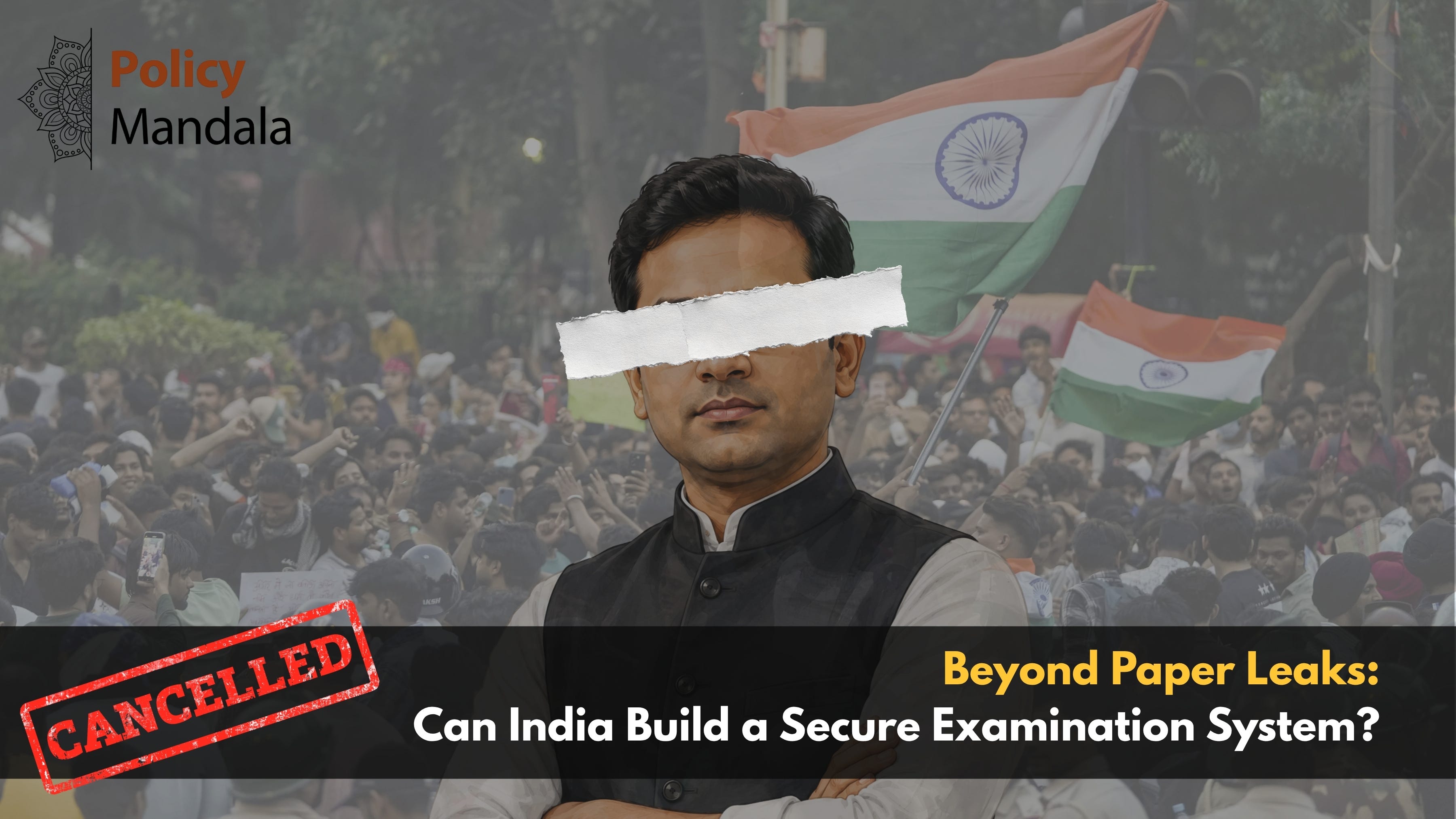
A paper leak may look like a mere administrative failure. But for a student, it can make years of effort feel suddenly meaningless.
Since 2015, paper leaks have accounted for nearly 70% of documented examination fraud cases, up from about 32% before 2015. The consequences extend far beyond cancelled examinations, to public mistrust and psychological damage to millions of young minds.
Recently, in the wake of the growing outrage and protests, the parliament passed amendments to the Public Examinations Act of 2024 to further strengthen the law with stricter penalties against organised examination fraud.
But can tougher punishments and fear of punitive action solve the problem? Or do we need deeper systemic and institutional reforms? With the futures of crores of students each year at stake, we chose to explore these questions in today’s Policy Mandala.
Paper leaks are not new. From the Vyapam scam and the 2015 AIPMT leak to NEET-UG and UGC-NET in 2024, major examinations have repeatedly been compromised. Despite differences in scale, these cases point to common recurring weaknesses in India’s examination system.
But something has changed that makes today’s exams even more vulnerable.
Earlier, examination fraud was largely confined to the examination hall and a select few with the means to take advantage. Today, a single photograph of a question paper can spread to thousands before the first student enters the room.
The law today responds to this new reality by criminalising organised cheating, paper leaks and the unauthorised disclosure of examination material. The recent amendment is on the same line as it increases penalties, creates a Special Task Force, and sets tighter timelines for investigation and trial through fast-track courts.
But do punitive measures such as the new amendment actually work?
While punishments do create a certain sense of fear in the minds of those behind the leaks, deterrence does not depend only on harsher punishment. This is evident from the fact that even after the 2024 Act criminalised examination fraud, at least five widely reported paper-leak episodes surfaced across national, state-board and university examinations, including NEET-UG 2026.
Deterrence also depends on the certainty of detection and delivery of justice.
In many paper-leak cases, investigators catch local intermediaries, while the masterminds and sometimes even institutional insiders remain beyond the reach of law enforcement.
Stronger punishment alone cannot compensate for weak detection. Even when those behind a leak are identified, investigations and trials often drag on for years, while accused individuals secure bail long before the case reaches a conclusion. That is why the amendments also try to rely on designated courts to deliver faster trials.
But can faster courts compensate for weak investigations?
India’s own experience suggests otherwise. Fast-track courts under the Nirbhaya reforms and the POCSO framework continue to struggle with vacancies and case backlogs. As of August 2025, the average trial duration in POCSO Fast Track Special Courts ranged from 257 days in Andhra Pradesh to 1,717 days in Delhi.
The timing of these amendments suggests the changes were as much a political response to restore public confidence as a governance reform. Although this becomes necessary to restore public trust in the system, political responsiveness is no alternative for structural reform.
So how do we move beyond punishment after a leak and towards a policy for securing the examination system itself?
First, secure the full examination supply chain.
A paper is exposed at each stage from question-setting and printing to transportation, storage and final conduct. A breach at any stage can compromise the entire process.
At the question-setting stage, paper setters should undergo rigorous vetting, disclose conflicts of interest and work through secure, access-controlled systems. JEE Advanced offers one useful example, with papers prepared under tightly controlled institutional processes led by senior IIT faculty.
Printing should then be limited to accredited, high-security presses with strict access logs, surveillance and clear chain-of-custody protocols. UPSC’s confidential printing arrangements, including printing across secure government facilities, offer one possible model.
Finally, distribution must be protected through secure storage, GPS-enabled transport, encrypted audit trails, time-locked access and round-the-clock surveillance. UPSC’s use of district administration for monitoring transportation and storage could inform wider examination reform.
Second, rebuild institutional capacity.
Over-centralisation and under-staffing of the examination ecosystem have taken a toll on the process. National Testing Authority (NTA), the designated body for conducting national examinations such as the NEET and JEE Mains, does not have any regional or state offices. Instead, reliance is placed on local coordinators, examination centres, government institutions and external service providers.
Even more strikingly, only about one in nine people working for NTA is a regular official, while everyone else is either contractual or outsourced. Today, the institution has only 24 permanent employees who manage examinations for more than 10 lakh students across the country.
Overhauling NTA, capacity augmentation through regional nodal offices and creation of a well-trained cadre for the examination system is hence a top policy priority. This also aids in accountability when things go wrong.
Unlike UPSC, which is a constitutional body, the NTA remains a society under executive regulation of the central government. Statutory recognition through a dedicated law could define its powers, governance structure, staffing norms, audit obligations and accountability for vendors and examination centres.
Third, protect the examinee.
When a paper leak cancels an examination, students lose fees, travel expenses, time and months of preparation, yet receive little beyond a new examination date.
A truly student-centric policy should provide fee and travel reimbursements, clear timelines for re-examinations and counselling support for affected candidates.
Equally important is restoring trust through annual examination calendars, greater decentralisation and stronger institutional capacity, not just harsher punishment.
India now faces a clear choice. It can continue responding to every leak with arrests, cancellations and tougher penalties, or it can redesign the institutions and processes that allow leaks to happen in the first place.
Whether we will do justice to innocent lives lost like Kahaan remains to be seen, and we will keep tracking policy development in this field for you at Policy Mandala.
Co-Authored by: Samridh Joshi and Avdhesh Pathak


