
Shyam, a farmer in Bihar, is waiting for water to enter the canal and reach his fields. The seeds have been sown. The field is ready. The crop now depends on irrigation. But today, the canal remains dry, and Shyam begins to worry.
What he does not know is that hundreds of kilometres upstream, in another state, water has been held back through a dam. For Shyam, the problem is immediate. For governments and political parties, it can become a contentious issue shaping negotiations, inter-state relations and electoral politics.
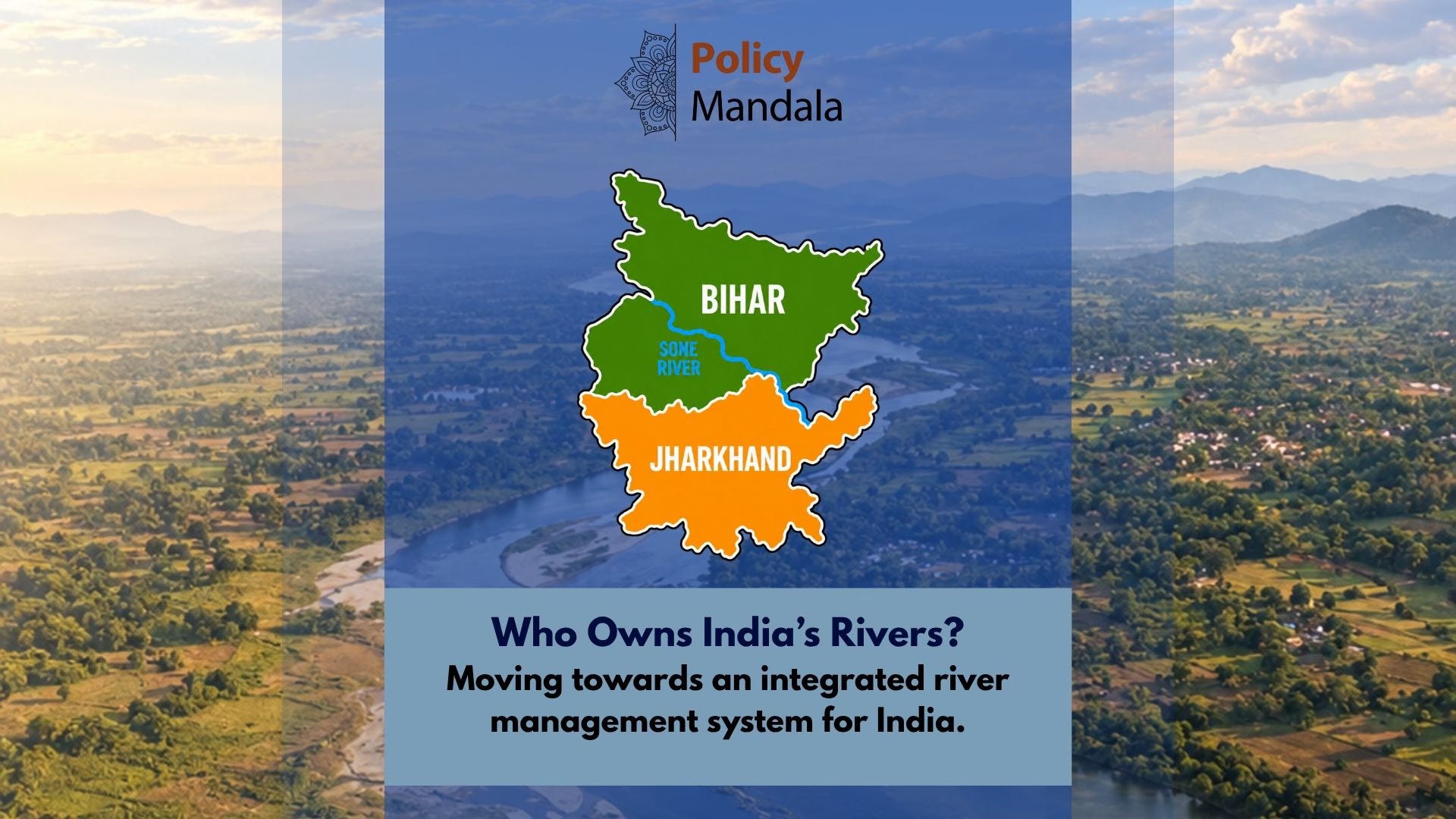
Who controls the flow of a river when the river is shared by more than one state?
This is at the heart of India’s inter-state water disputes. Upstream states often control dams, reservoirs and barrages, while downstream states depend on the quantity and timing of water released.
The Sone dispute between Bihar and Jharkhand reflected this tension. After nearly 25 years, the two states signed an agreement on 31 August 2026 to divide their share of Sone waters.
But the larger question remains: How should India govern rivers when water is shared across states, but control over its flow is not?
In this edition of Policy Mandala, we explain how India manages inter-state river disputes and explore what a more durable river-basin management framework could look like.
So, why do inter-state water disputes arise?
A river rarely belongs neatly within one state. It may originate in one, receive water from tributaries across several others and flow downstream into another, with its volume changing across seasons.
Along the way, states build dams and barrages to store and divert water for agriculture, cities and industries. But every upstream use can affect what reaches downstream. As states stake competing claims over this shared and finite resource, a basic question emerges: who gets how much water?
Such disputes have existed since Independence and have, at times, turned violent. The Cauvery dispute between Karnataka and Tamil Nadu is perhaps the starkest example. In 1991, the tribunal’s interim award triggered widespread violence in Karnataka, including attacks on Tamil residents.
The Constitution anticipated this challenge. Article 262 empowered Parliament to create a special mechanism for adjudicating inter-state river disputes and, where provided by law, exclude ordinary court jurisdiction.
Parliament operationalised this through two laws in 1956. The River Boards Act enabled advisory bodies for coordinated regulation and development of inter-state rivers. The Inter-State River Water Disputes Act created the adjudicatory route: when negotiations fail, the Union may constitute a tribunal to investigate the dispute and issue a binding decision.
Both mechanisms have limitations. No River Board has ever been constituted under the River Boards Act, leaving India without the basin-level coordination architecture the law envisaged. Tribunals have functioned, but remain judicially dominated, with technical experts largely serving as assessors rather than adjudicators.
They have also been slow. The Cauvery Tribunal, for instance, was constituted in 1990 and delivered its final decision only in 2007. India’s problem, therefore, is weak continuous basin management on one side and prolonged adjudication on the other.
So, what should India’s river water management policy look like?
Any framework must begin by recognising that rivers are natural systems, not administrative ones. State boundaries are relatively recent; river basins cut across several political jurisdictions.
River management also cannot simply be about dividing a fixed quantity of water. A basin connects rainfall, tributaries, groundwater, agriculture, cities, industries and ecosystems. Economic, hydrological and environmental considerations therefore need to be managed together.
Water sharing is also inherently political. States have different needs, historical claims and development priorities. Any durable arrangement requires consensus-building and sustained buy-in from basin states.
Finally, rivers are dynamic. Rainfall, demand, land use and climate conditions change. Management must therefore be continuous and adaptive, rather than beginning only after a dispute reaches a tribunal.
We believe an ideal framework for managing India’s inter-state rivers should rest on three layers.
The first should be permanent basin-level management. Major inter-state rivers need institutions for joint planning, reliable data-sharing, infrastructure coordination and management of water, floods, groundwater and ecology. Basin plans should be periodically reviewed as rainfall, demand and land use change.
The Draft River Basin Management Bill, 2018 provides a useful starting point. It proposed basin-level institutions for integrated planning and coordination among states, but was never enacted.
The second layer should be political consensus. Cooperation can create different costs and benefits for different states, making political buy-in essential. The Union could support this through fiscal and financial incentives, linking funding for irrigation, flood management, restoration and water efficiency to participation in agreed basin plans. The aim should be to make cooperation more rewarding than continued contestation.
The third layer should be dispute resolution, with adjudication as a backstop rather than the starting point. The Inter-State River Water Disputes (Amendment) Bill, 2019 offers useful building blocks, including structured negotiation, greater technical participation, common data and a more permanent dispute-resolution mechanism. It too did not become law.
Together, the 2018 and 2019 proposals can form the starting point for a new framework: one focused on basin management, the other on dispute resolution. India now needs to connect the two through continuous management, negotiated cooperation and credible adjudication.
Such a framework would ultimately require Parliamentary legislation. But political consensus must come first. States must see basin cooperation not as surrendering control over water, but as a way to secure more predictable and mutually beneficial outcomes.
An ad hoc approach cannot be India’s long-term answer. Water sits at the intersection of politics, development, livelihoods and ecology, and reconciling competing interests will require sustained negotiation and trust.
The future of inter-state water governance must lie in managing river basins continuously, building political consensus early and using adjudication only when cooperation fails.
For Shyam, this may sound like a distant institutional debate. But ultimately, good river governance is about something immediate: ensuring that decisions taken hundreds of kilometres upstream do not leave those downstream waiting endlessly for water.
Authored by Samridh Joshi, Avdhesh Pathak and Sameer Rao
Read Our Previous Editions:
#54 From Records to Rights

In Kaagaz, Pankaj Tripathi plays a man who discovers something absurd: he is alive, but government records say he is dead.
#53 One Nation, One Time

You make a UPI payment at your local grocery store at 7:30 PM. Your bank records it at exactly 7:30 PM, while the payment gateway logs it a fraction of a second earlier. Both display Indian Standard Time (IST), yet their timestamps may differ because their clocks are synchronised to different underlying sources.
#52 The Mining Bargain: Who Owns India’s Minerals?

You return home after a long day, switch on the lights and plug in your phone. The electricity powering your daily life may have begun hundreds of kilometres away, inside a coal mine in Jharkhand, Odisha or Chhattisgarh.