
Think of the view up Raisina Hill from Vijay Chowk: two grand sandstone buildings, their domes framing the road to Rashtrapati Bhavan. Most Indians have seen them during Republic Day broadcasts, even if they have never stepped inside.
For nearly a century, North and South Block witnessed India’s budgets being drawn up, defence decisions being made, and ministers moving between meetings. Now, with most government offices relocated to Kartavya Bhawans and Seva Teerth, these buildings are preparing for a different role: housing India’s past.
Recently, the Union Cabinet approved the Yuge Yugeen Bharat Museum, a ₹3,230-crore project to turn the two blocks into a museum showcasing India’s 5,000-year civilisational journey. The museum is expected to open in phases, beginning in 2027 and continuing through 2030–31.
The ambition is enormous. The museum is being designed to accommodate around one crore visitors a year. Nearly 1.8 million objects have been identified for potential display, drawn from the National Museum, 52 Archaeological Survey of India (ASI) site museums, state museums and private collections.
But these objects will not appear out of nowhere. They already have homes, and people responsible for keeping them safe. Before bringing them together in a new museum, it is worth asking: how well are those existing institutions doing?
In today’s Policy Mandala, we ask: who actually runs India’s museums, and can a grand new flagship succeed if the system beneath it is struggling?
To answer that, we need to know who runs a museum in India. The short answer: it depends.
One might assume that the Ministry of Culture oversees museums across the country. But the reality is far more complicated. The ministry manages major institutions such as the National Museum in Delhi, while the ASI looks after archaeological site museums.
State governments run their own museums, and municipal bodies, universities, trusts and private owners manage many others. Even the Constitution divides legislative responsibilities between the Centre and states.
There is no single authority responsible for managing India’s museums.
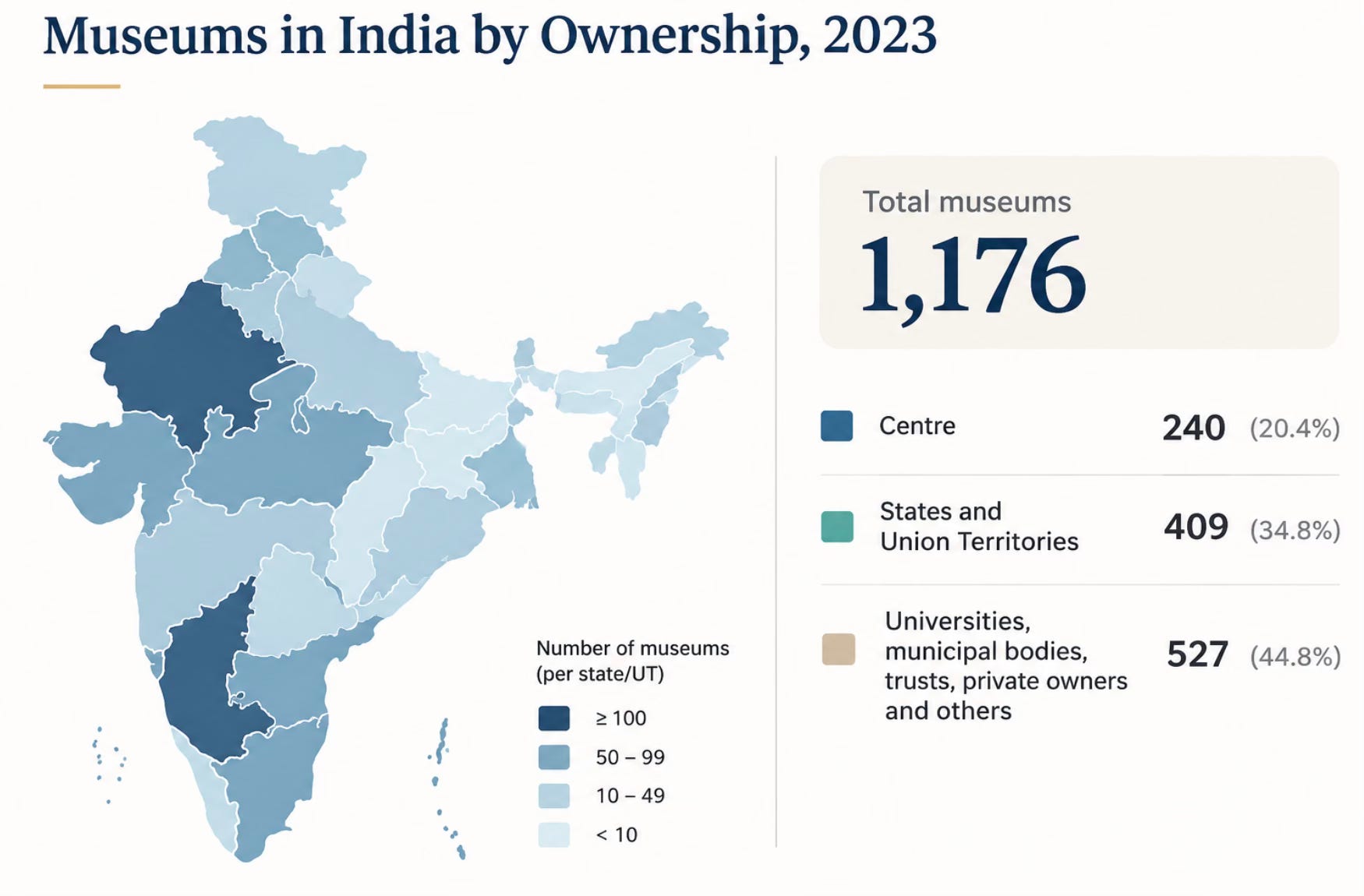
The numbers tell the story. The Ministry of Culture’s 2023 directory lists 1,176 museums across India. Of these, 240 are under the Centre, 409 under states and Union Territories, and 527 under universities, municipal bodies, trusts, private owners and other institutions.
Having different institutions manage museums is not necessarily a problem. But it does mean that their powers and responsibilities can vary considerably. A museum director may be responsible for maintaining a building, conserving artefacts and protecting collections, yet depend on a ministry or another parent institution to approve repairs, recruit specialists or sanction expenditure.
When responsibility and decision-making powers do not align, even routine improvements can become difficult.
This fragmentation also shapes how museums are financed. A museum run by a central ministry, another by a state department and a third by a university or private trust operate under very different financial arrangements. Their budgets, sources of income and freedom to use available funds vary considerably.
At Delhi’s National Museum, for instance, even ticket revenue goes into the government’s account rather than being available for the museum to spend directly. Without predictable funding and sufficient financial autonomy, planning for maintenance, conservation and long-term improvements becomes difficult.
But the freedom to spend money is only half the question. How much funding is available in the first place?
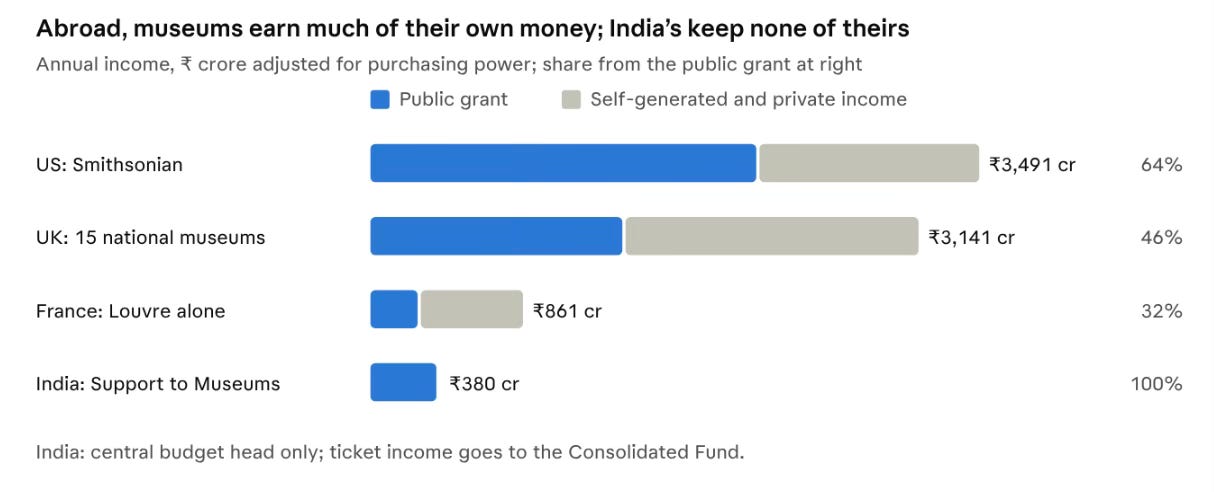
Consider the financial resources available. In 2026–27, the Union Ministry of Culture allocated around ₹676 crore across its three museum-related budget heads. The Louvre in Paris alone had annual resources of approximately ₹3,400 crore in 2025, nearly five times as much. Its earnings from ticketing and related visitor services alone were more than double India’s central museum allocation.
And even the money that is available does not always translate into work on the ground. In 2025–26, the ministry released ₹5 crore for a music museum in Gwalior, out of which only ₹2.26 lakh had been spent, less than half a percent of the funds released.
Money is not the only resource museums need. They also need people who know how to preserve what they hold. At Kolkata’s Indian Museum, a 2026 government reply reported 80 vacancies against 138 sanctioned posts. Conservators and other specialists take years to train, and their work is essential to protecting fragile collections. Without them, a museum risks becoming little more than a storeroom with a ticket counter.
The challenge, then, is not simply one of fragmented administration or insufficient funds. It is about whether museums have the right combination of resources, professional expertise and decision-making powers to fulfil their responsibilities.
So where should the change begin?
First, rethink how museums are funded and managed. Look at the British Museum, governed by trustees, or the Louvre, which has its own governing board. Both receive government support but also mobilise resources through donations, sponsorships and commercial activities.
India could explore similar models for major museums, with professionally constituted boards bringing together conservation experts, administrators and financial expertise.
Second, bring private partners into the picture. India has already begun experimenting with this approach in heritage conservation. Under the Adopt a Heritage 2.0 programme, companies and civil society organisations can support visitor facilities at protected monuments while the ASI oversees conservation. The iconic Red Fort and Qutub Minar were adopted under this scheme by major industrial houses.
Similar partnerships could help museums mobilise resources, improve maintenance and visitor experiences, and access specialised expertise, while public institutions retain ownership and oversight of their collections.
Third, help museums work together. Not every museum can afford its own conservation laboratory or a full team of specialists. But what if museums could share these resources? Regional conservation facilities, travelling exhibitions, research partnerships and shared professional expertise could make a considerable difference, particularly for smaller institutions.
The idea is not to bring all 1,176 museums under one authority. It is to ensure that each has the resources, expertise and decision-making powers needed to protect what it holds.
And what does all this mean for Yuge Yugeen Bharat?
There is a strong case for its ambition. The National Museum in Delhi holds over two lakh objects, many of which remain in storage, and received only around 4.2 lakh visitors in 2024–25. A new museum capable of accommodating one crore visitors annually could bring India’s civilisational heritage to a much wider audience.
But imagine if its impact went beyond the number of visitors entering its galleries. What if Yuge Yugeen Bharat also became a model for how India’s museums should be run? An institution that demonstrates professional management, financial autonomy, modern conservation practices and meaningful partnerships. And one that shares its expertise and resources with the smaller museums from which India’s heritage is being brought together.
After all, the success of a museum cannot be measured only by how many people visit it. It must also be measured by how well it protects the heritage entrusted to it.
North and South Block once housed the institutions that governed India. Now, they have an opportunity to demonstrate how India can preserve its past. For Yuge Yugeen Bharat, the real opportunity is not just to build a world-class museum, but to show what a fresh approach to museum management could look like across the country.
Co-authored by Shrinithi Raman and Samridh Joshi
Read Our Previous Editions:

#58 Decoding India’s logistics problem:

In today’s Policy Mandala, we are decoding the logistics that keep a nation moving. Before we delve into the details, let us take you to Jaigarh.
#57 Who Really Governs India's Cities?

I live in Saket, Delhi, and last month, after heavy rainfall, the road outside my house was waterlogged. It was not surprising, but as a student of public policy, this time I wanted to raise a complaint.
Wouldn't a scheme like adopt a heritage lead to monopoly, inflation, or increase inaccessibility to art and culture?