
It is December. You take an early morning flight to New Delhi for a meeting. The plane lands, the doors open, and before the city can even greet you, your eyes begin to burn. Outside the airport, the skyline has disappeared into a thick grey haze.
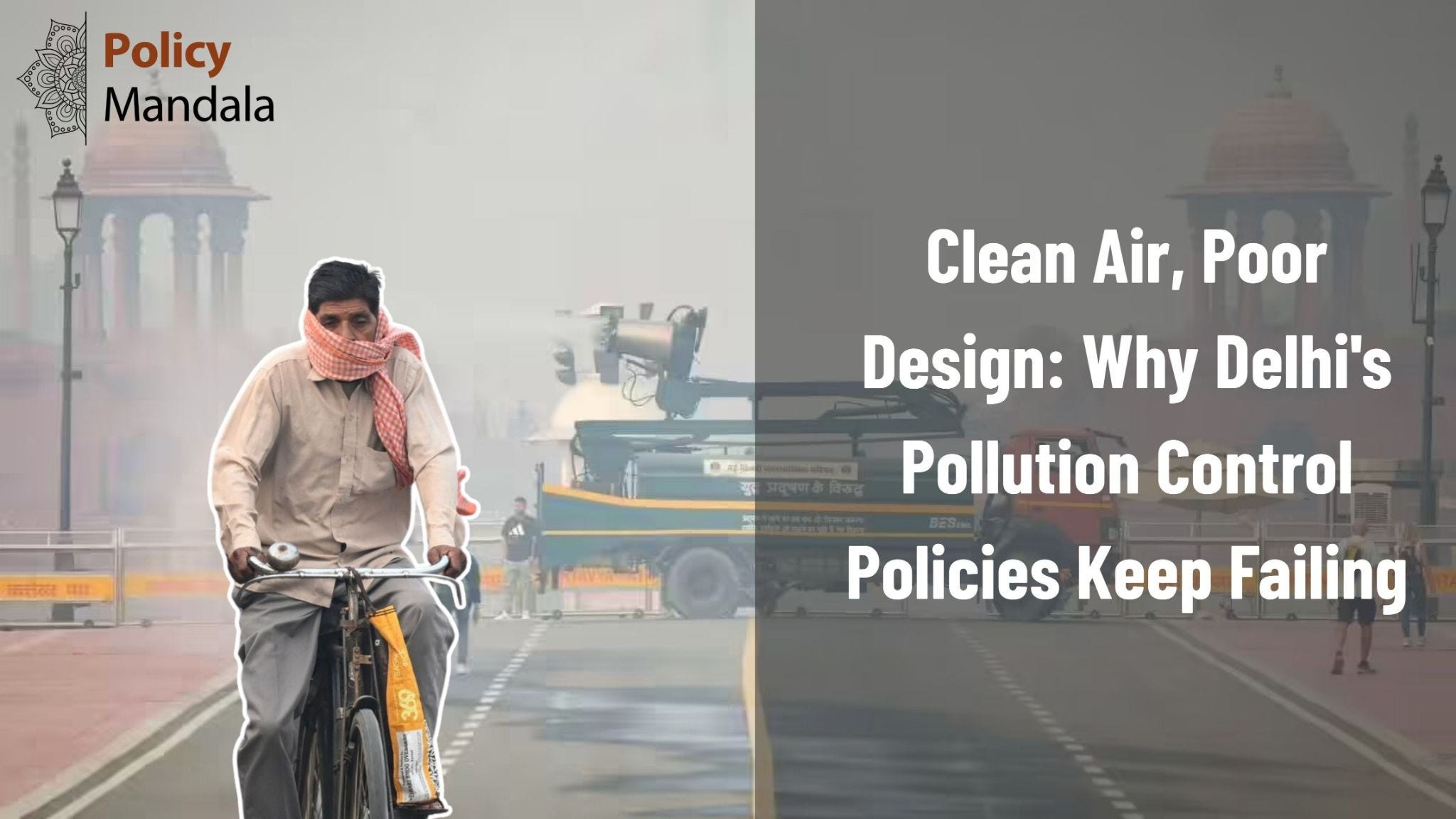
For nearly 6 crore residents of Delhi-NCR, this is not an occasional travel inconvenience. It is an annual reality.
Delhi’s air pollution crisis is not just about bad visibility or cancelled flights. It is a public health emergency, estimated to reduce the life expectancy of an average Delhi resident by nearly 8.2 years.
Faced with worsening air quality, the Government of India launched the National Clean Air Programme (NCAP) in 2019. Rather than being a single pollution-control scheme, NCAP coordinates the efforts of central ministries, state governments and urban local bodies to improve air quality across India’s most polluted cities including Delhi.
And yet, despite the efforts through the NCAP in the seven years that followed, Delhi’s average air quality only improved by 15% and still ends up in the ‘severe’ category.
We believe that NCAP got the diagnosis right. But it failed to build the machinery needed to act on that diagnosis.
Realising the deficiencies in the NCAP, a few days earlier the Delhi Government launched ‘Swachh Hawa, Swasth Delhi’, a seven-year air pollution mitigation plan to revamp the NCAP. Backed by the World Bank, it brings over ₹8,300 crore in funding, more than 100 times the earlier allocation.
But was the failure of NCAP driven only by the lack of funding? Or was it a systemic design flaw in the scheme? And can the new Mitigation Plan solve the crisis or will things still remain the same?
These are the questions that we will answer in today’s Policy Mandala.
To understand why air pollution control plans like NCAP struggle, we first need to understand Delhi’s pollution problem.
Delhi’s air pollution is driven by particulate matter and harmful gases from vehicles, construction, industries, waste burning, and seasonal crop-residue burning in neighbouring states. Winter weather then traps these pollutants close to the ground, creating Delhi’s toxic haze.
The problem becomes complex because the sources are spread across sectors and jurisdictions. Vehicles are regulated by transport departments, construction by urban bodies, industries by pollution boards, waste burning by municipalities, and crop burning by neighbouring states.
So how did the NCAP plan to solve this crisis?
In its core, the NCAP got one thing right: Delhi’s air pollution cannot be solved by one ministry or one city alone. Since pollutants come from various sources and locations, it created a framework where multiple levels of government could coordinate action instead of working in silos.
NCAP also equipped Delhi with a wide toolkit: expanded monitoring and forecasting systems, GRAP-based emergency measures, cleaner fuel and vehicle norms, crop-residue support, and a dedicated NCR coordination body through CAQM.
Then, why did Delhi still end up with a toxic haze in 2026?
Our argument is that NCAP’s components are heavily weighted toward monitoring, standard-setting, and reporting infrastructure or the diagnostic layer. What was missing in the original design was a dedicated enforcement or fund-disbursement mechanism at the city level.
A policy is as good as its implementation mechanism and a lack of such a mechanism in the NCAP led to its ineffectiveness.
This becomes more evident when we look at the facts. Delhi spent only 17% of the ₹81 crore allocated over seven years. Pollution-control bodies remained nearly 30% understaffed, and NCAP created no statutory authority to coordinate implementation.
So, will the new mitigation plan deliver what it promises, a ‘Clean Air’ for Delhi ? We believe it will solve some deficiencies of NCAP but will still remain short of its promise.
The biggest advantage of the new plan may not be the ₹8,300 crore itself, but the discipline attached to it. World Bank-backed programmes typically come with stricter monitoring, audits, and fund-utilisation requirements. If Delhi wants the money to keep flowing, it will have to show better planning, implementation, and financial accountability.
The second highlight is pollution source monitoring. Since we cannot precisely trace pollution to where it originates, control becomes extremely difficult. The new plan includes creating a pollution source inventory by 2027. This, combined with a Project Management Unit (PMU) and an Integrated Command and Control Centre (ICCC), should make monitoring more targeted.
But, better monitoring is not the same as better enforcement. Neither does the plan fix critical administrative issues including staffing, nor does it create a statutory implementation unit.
At India House, we often evaluate policy through a simple framework called PFACTS. A good policy must be Politically Acceptable, Financially Viable, Administratively Doable, Culturally Relatable, Technologically Feasible and Socially Desirable.
Delhi’s updated clean-air policy already passes some of these tests. It is socially desirable. The World Bank funding makes it financially more viable. Source inventories, PMUs and command centres improve technological feasibility.
But the weak points remain political acceptability and administrative doability.
Take stubble burning. A significant part of Delhi’s winter pollution comes from crop residue burning in Punjab and Haryana. NCAP recommends alternatives, but enforcement remains politically difficult because these measures impose costs on farmers, an important voting bloc. As a result, stubble burning has actually increased over the years.
This is where policy design matters. A politically acceptable solution may not always begin with a ban.
Studies suggest that even nudging farmers to burn stubble a few hours earlier could reduce air-quality impacts and avoid thousands of deaths annually, without requiring new machinery or subsidies. It is not a complete solution, but it shows how small behavioural changes can reduce harm when larger reforms are politically difficult.
The administrative challenge is equally serious. Delhi’s new mitigation plan should tie funding to measurable milestones: filling vacancies, strengthening pollution-control bodies and devolving enforcement authority.
The lesson is simple, targets do not clean the air, institutions and policy design does. The new plan brings money, monitoring and technology. That is progress. But unless it also builds authority, accountability and political buy-in, Delhi may still return to the same winter script.
Delhi’s problem is no longer identifying pollution. It is implementing solutions.
We will be tracking Delhi’s air over the next few months. As winter approaches and the fires reignite across the farms, it remains to be seen whether Delhi will finally breathe easier, or whether your eyes will burn again when you land in the capital.
Co-authored by Samridh Joshi & Avdhesh Pathak


